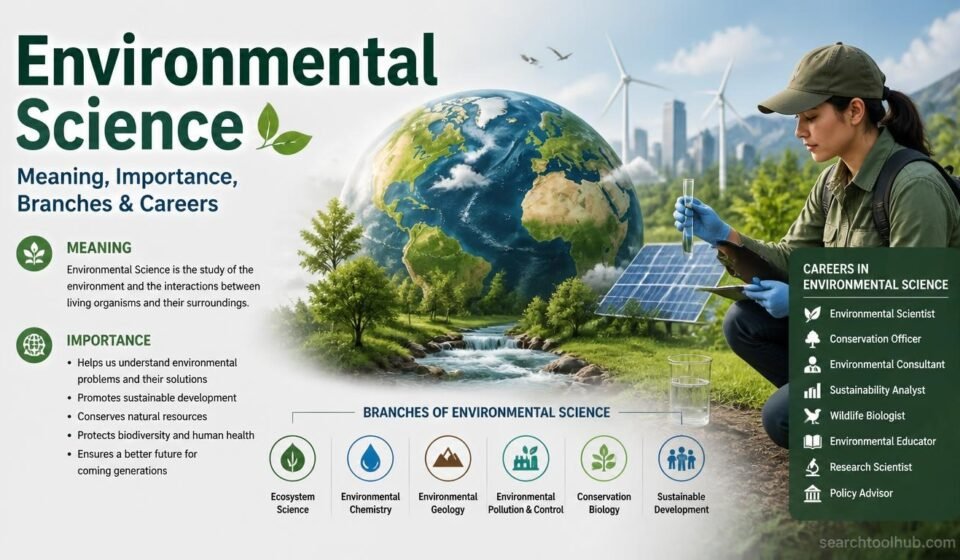

Environmental science helps us understand the natural world and the impact human activities have on it. From air pollution and climate change to water conservation and biodiversity, this field explores the environmental challenges that affect people, wildlife, and ecosystems. It combines knowledge from biology, chemistry, physics, geology, and geography to investigate how the environment works and how it can be protected.
As environmental challenges become increasingly important around the world, understanding environmental science is useful for students, researchers, businesses, communities, and policymakers. Whether you are exploring this subject for school, considering a university degree, or simply interested in protecting nature, learning its basic principles can help you make better decisions.
If you want to explore the wider subject, read our
“Science: Meaning, Branches, Education, Careers, and Everyday Discoveries“
This guide explains what environmental science is, its main branches, why it matters, educational opportunities, career options, and practical ways people can contribute to environmental protection.
What Is Environmental Science?
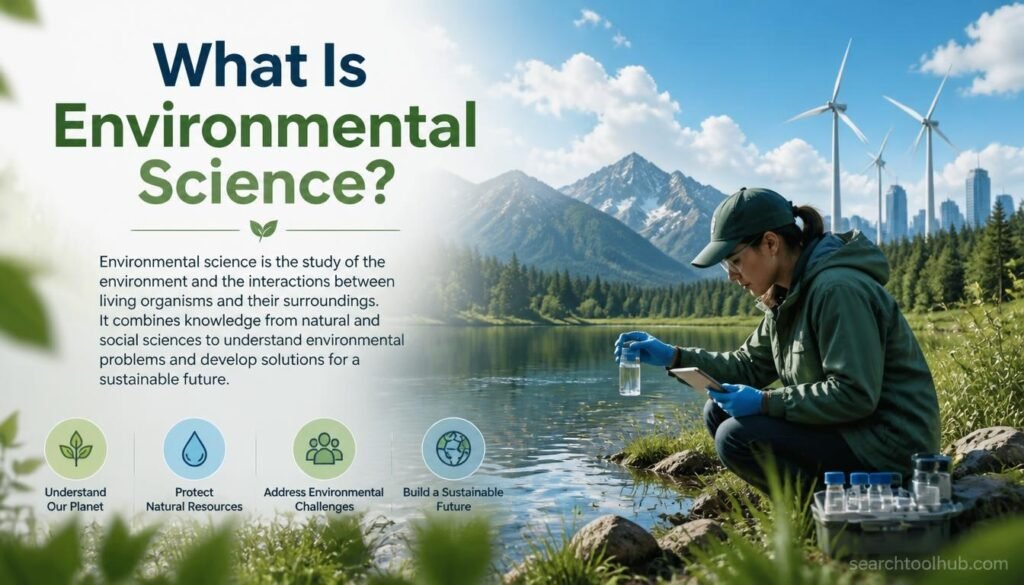
Environmental science is the interdisciplinary study of the natural environment and the relationships between living organisms, humans, and physical surroundings.
It examines how natural systems function and how human activities influence them. Researchers study subjects such as air quality, water resources, soil conditions, ecosystems, climate patterns, pollution, and biodiversity.
For example, an environmental scientist investigating water pollution might collect water samples, measure chemical concentrations, identify possible pollution sources, and evaluate the effects on aquatic life.
Environmental science uses scientific evidence to understand environmental problems and identify possible solutions. It does not rely only on opinions or assumptions. Instead, it combines observation, research, measurements, and analysis.
Why Is Environmental Science Important?
Essential resources including clean air, fresh water, fertile soil, food, and natural ecosystems are provided by the environment. People can better grasp how to manage these resources properly with the aid of environmental science.
Its importance is demonstrated in several domains.
1. Understanding Climate Change
Long-term variations in temperatures and weather patterns are part of climate change. Human activities, particularly the release of greenhouse gases from burning fossil fuels, have contributed significantly to recent global warming.
Environmental researchers study temperature records, atmospheric conditions, ocean changes, and other evidence to understand climate patterns and their consequences.
2. Reducing Air and Water Pollution
Air and water pollution can affect human health, wildlife, and ecosystems. Environmental science helps identify pollutants, investigate their sources, and evaluate methods for reducing contamination.
Research may involve monitoring industrial emissions, testing drinking water, and examining the effects of waste disposal.
3. Protecting Biodiversity
The variety of living things, such as plants, animals, fungi, and microorganisms, is referred to as biodiversity.
Healthy ecosystems depend on interactions between different species. Environmental science helps researchers understand habitat loss, endangered species, invasive organisms, and conservation strategies.
4. Managing Natural Resources
Natural resources include things like soil, water, minerals, forests, and energy sources. Communities and organizations can better understand how to use these resources without needlessly harming the environment thanks to environmental research.
5. Supporting Sustainable Development
Sustainable development aims to improve people’s quality of life while considering environmental protection and the needs of future generations.
Environmental science contributes to decisions about renewable energy, urban planning, agriculture, transportation, and waste management.
Main Branches of Environmental Science
Environmental science includes several connected disciplines. Each branch focuses on different aspects of the environment.
Environmental Biology
Environmental biology studies living organisms and their relationships with their surroundings.
It includes research into ecosystems, wildlife populations, habitats, biodiversity, and the effects of environmental changes on plants and animals.
Environmental Chemistry
Environmental chemistry examines the chemical processes occurring in air, water, soil, and living systems.
Scientists in this area may investigate pesticides, heavy metals, industrial chemicals, water contamination, and chemical reactions in the atmosphere.
Environmental Geology
Environmental geology studies the relationship between geological processes and environmental conditions.
Topics include soil erosion, groundwater resources, natural hazards, land contamination, mineral resources, and geological changes.
Ecology
The study of how living things communicate with their natural surroundings is known as ecology.
Ecologists study food webs, population changes, ecosystems, habitats, and the flow of energy through natural systems.
Atmospheric Science
Atmospheric science focuses on the Earth’s atmosphere, including weather, climate, air composition, and atmospheric processes.
It contributes to weather forecasting, climate research, and the study of air pollution.
Environmental Hydrology
Environmental hydrology studies water movement, distribution, and availability in natural systems.
It is important for understanding rivers, groundwater, rainfall, watersheds, flooding, and water-resource management.
Major Environmental Issues Studied by Scientists
Environmental science investigates problems that can affect communities and ecosystems at local, regional, and global levels.
Climate Change and Global Warming
The long-term rise in Earth’s average surface temperature is referred to as global warming. Wider variations in weather patterns, precipitation, extreme events, and other climate conditions are all part of climate change.
Scientists study these changes using observations, climate models, satellite measurements, and historical records.
Deforestation
Deforestation is the removal of forests, often to create agricultural land, expand settlements, or obtain timber and other resources.
It can destroy wildlife habitats, reduce biodiversity, affect soil conditions, and influence the carbon cycle.
Plastic and Solid Waste Pollution
Both on land and in aquatic habitats, plastic garbage can build up. Pollution, habitat destruction, and danger to wildlife can all result from improper trash disposal.
Environmental scientists investigate waste-management methods, recycling systems, material alternatives, and the effects of plastic pollution.
Soil Degradation
Soil degradation involves a decline in soil quality and its ability to support plants and ecosystems.
Causes may include erosion, salinization, contamination, deforestation, and unsuitable agricultural practices.
Water Scarcity
Water scarcity occurs when available water resources are insufficient to meet the needs of people, agriculture, industry, and ecosystems.
Environmental research helps assess water availability, groundwater use, pollution, and conservation opportunities.
Environmental Science Education and Degrees
Environmental science is offered through different educational pathways, depending on the country and institution.
Students may encounter it as a school subject, a university major, or part of a broader science program.
Studying Environmental Science at School
School-level environmental science introduces students to ecosystems, pollution, conservation, natural resources, climate, and human impacts on nature.
Practical activities can make the subject easier to understand. For example, students may compare soil samples, observe local plants, record weather conditions, or investigate household waste.
Environmental Science at University
University programs often combine scientific theory with practical research.
Common subjects may include:
- Biology and ecology
- Chemistry
- Geology
- Environmental statistics
- Climate science
- Water-resource management
- Environmental policy
- Conservation
- Research methods
Some programs also include fieldwork, laboratory activities, internships, and research projects.
Is Environmental Science a Good Degree?
Environmental science can be a suitable degree for students interested in nature, scientific research, sustainability, conservation, and environmental problem-solving.
Before choosing a program, students should compare its curriculum, practical training, entry requirements, tuition fees, accreditation, and career opportunities.
A degree’s recognition and professional value depend on the institution, country, and intended career.
Environmental Science Careers and Job Opportunities
Environmental science graduates may explore opportunities in research, environmental management, conservation, consulting, education, and public-sector organizations.
Career options depend on qualifications, practical experience, location, and employer requirements.
Environmental Scientist
Environmental scientists investigate environmental conditions, collect samples, analyze data, and prepare reports.
Their work may focus on pollution, water quality, soil conditions, ecosystems, or environmental management.
Environmental Consultant
Environmental consultants help organizations understand environmental risks and responsibilities.
They may support environmental assessments, compliance projects, monitoring programs, and sustainability planning.
Conservation Scientist
Conservation scientists work to protect natural resources, habitats, and ecosystems.
Their responsibilities may involve conservation planning, land management, habitat monitoring, and biodiversity research.
Environmental Researcher
Environmental researchers investigate scientific questions through field studies, laboratory experiments, data analysis, and academic research.
They may specialize in climate, ecology, pollution, water, or other environmental topics.
Environmental Educator
Environmental educators help students and communities understand environmental issues and responsible resource use.
They may work in schools, educational organizations, nature centers, museums, or community programs.
Environmental Health and Safety Professional
These professionals help organizations identify and manage risks involving workplace safety, environmental protection, and regulatory responsibilities.
Some roles require additional specialist qualifications or professional certifications.
Environmental Science in Everyday Life
Environmental science is not limited to universities and research laboratories. Its principles can be applied in ordinary activities.
Reducing Household Waste
Separating recyclable materials, avoiding unnecessary packaging, and disposing of waste responsibly can help reduce environmental pressure.
Conserving Water
Fixing leaks, using water carefully, and avoiding unnecessary waste can support more responsible water use.
Saving Energy
Using energy-efficient appliances, switching off unused equipment, and improving insulation can reduce energy consumption.
Protecting Local Biodiversity
Planting suitable native species, protecting habitats, and avoiding disturbance to wildlife can support local ecosystems.
Making Informed Consumer Choices
Understanding product materials, packaging, durability, and disposal methods can help consumers evaluate the environmental impact of their purchases.
Individual actions are useful, but larger improvements also require effective infrastructure, public policies, scientific research, and responsible organizational decisions.
Environmental Science and Technology
Modern technology has expanded the ways researchers study environmental conditions.
Satellite Monitoring
Satellites help scientists observe land-use changes, forest cover, ocean conditions, atmospheric patterns, and other environmental indicators.
Geographic Information Systems
Geographic Information Systems, commonly called GIS, allow researchers to organize and analyze location-based information.
GIS can help map flood risks, wildlife habitats, pollution sources, and land-use patterns.
Artificial Intelligence and Data Analysis
Artificial intelligence and data-analysis techniques can help researchers examine large datasets, identify patterns, and support environmental monitoring.
These tools are useful, but their results still need scientific evaluation and appropriate data.
Renewable Energy Research
Environmental research supports the development and assessment of renewable energy technologies, including solar, wind, and hydropower.
Scientists examine their performance, environmental effects, resource requirements, and potential contributions to reducing emissions.
Environmental Science Research: How Does It Work?
Environmental research generally follows a structured process.
Step 1: Identify a question. Researchers define the environmental issue they want to investigate.
Step 2: Collect information. They gather existing research, measurements, observations, or samples.
Step 3: Analyze evidence. Data may be examined using statistical methods, laboratory testing, mapping, or computer models.
Step 4: Interpret the findings. Researchers consider what the evidence shows and identify its limitations.
Step 5: Communicate results. Findings may be shared through scientific reports, academic publications, presentations, and public information.
For example, a study of river pollution may compare water samples from different locations and investigate possible sources of contamination.
Scientific research is strongest when methods are transparent, measurements are reliable, and conclusions are supported by evidence.
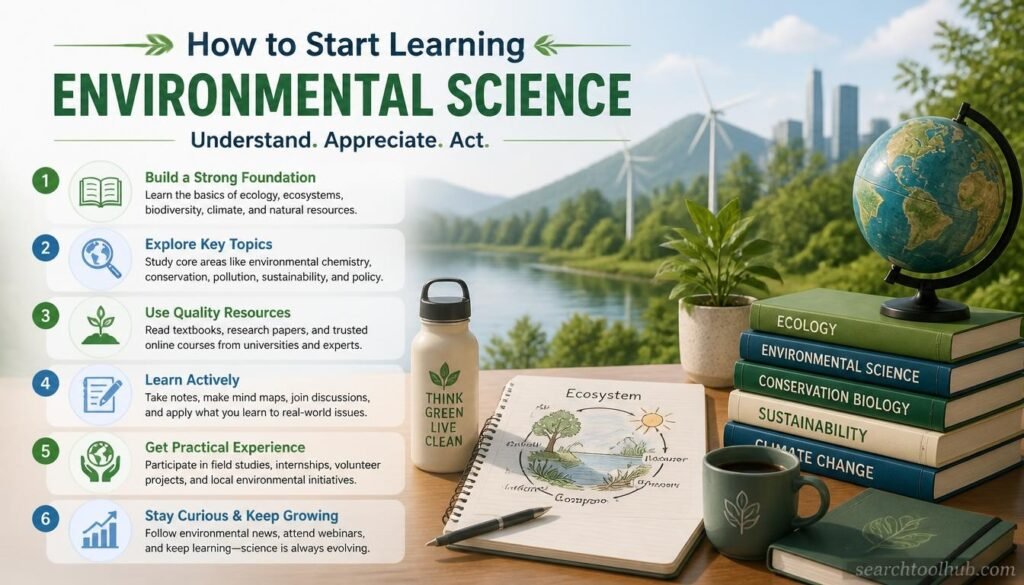
How to Start Learning Environmental Science
Beginners do not need advanced scientific equipment to start learning about the environment.
Here are some useful approaches:
- Learn basic concepts in biology, chemistry, geography, and Earth science.
- Read reliable educational resources and scientific explanations.
- Observe local weather, plants, water sources, and habitats.
- Practise recording measurements and observations.
- Explore environmental reports and research findings.
- Participate in suitable community conservation or citizen-science projects.
- Develop basic data-analysis and research skills.
Students should also learn to distinguish reliable scientific evidence from unsupported environmental claims.
The Future of Environmental Science
Environmental science will remain important as communities respond to changing environmental conditions and growing demands on natural resources.
Future research will continue to explore climate adaptation, biodiversity conservation, sustainable agriculture, pollution prevention, clean energy, water management, and ecosystem restoration.
Advances in satellite technology, artificial intelligence, sensors, and data science are also creating new opportunities for environmental monitoring.
However, technology alone cannot solve every environmental problem. Progress requires reliable scientific evidence, responsible policies, public participation, and cooperation between communities and organizations.
Conclusion
Environmental science helps us understand the connections between people, natural resources, and ecosystems. By combining knowledge from biology, chemistry, geology, ecology, and other disciplines, it provides valuable tools for investigating pollution, climate change, biodiversity loss, and resource management.
For students, it offers opportunities to explore scientific subjects and potential career pathways. For communities, it provides knowledge that can support better environmental decisions.
Understanding environmental science is an important step toward protecting natural systems and building a more sustainable future.
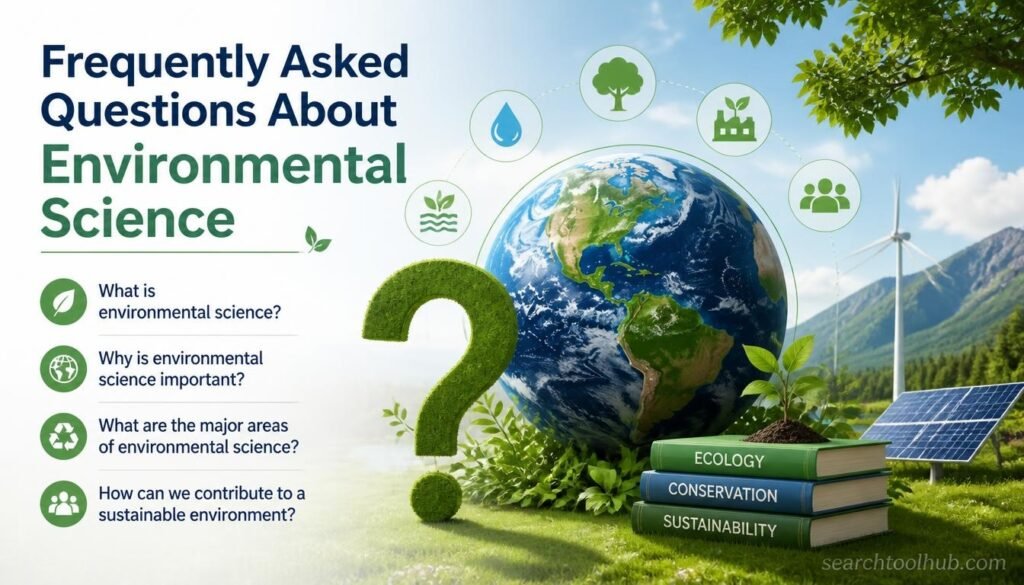
Frequently Asked Questions About Environmental Science
1. What is environmental science in simple words?
The study of the natural world and the interactions between living things, people, and their physical surrounds is known as environmental science. It looks at environmental issues and makes use of scientific data to comprehend potential fixes.
2. What are environmental science’s primary subfields?
Environmental biology, environmental chemistry, environmental geology, ecology, atmospheric science, and environmental hydrology are important fields. These fields collaborate to describe environmental issues and processes.
3. Why is environmental science important?
Environmental science helps people understand pollution, climate change, biodiversity loss, water scarcity, and natural-resource management. Its research supports conservation, public health, and sustainable development.
4. What subjects are needed to study environmental science?
Useful subjects include biology, chemistry, geography, mathematics, and physics. University programs may also include statistics, ecology, geology, and environmental policy.
5. Is environmental science a good career?
It can be a good career choice for people interested in scientific research, conservation, environmental management, and sustainability. Opportunities depend on education, experience, specialization, and local employment conditions.
6. What jobs can you get with an environmental science degree?
Possible career paths include environmental scientist, environmental consultant, conservation scientist, research assistant, environmental educator, and environmental health and safety professional.
7. What is the difference between environmental science and environmental studies?
Environmental science generally emphasizes scientific investigation of natural systems and environmental processes. Environmental studies is often broader and may include policy, economics, law, society, and human relationships with the environment. Program definitions vary between universities.
8. Can I study environmental science online?
Some universities and educational providers offer online environmental science courses and degree programs. However, certain subjects may require fieldwork, laboratory sessions, or supervised practical activities. Students should check program recognition and course requirements before enrolling.
9. How does environmental science help reduce pollution?
It helps identify pollutants, investigate their sources, measure their effects, and evaluate prevention or treatment methods. Research can support better waste management, cleaner production, water treatment, and environmental regulations.
10. How does environmental science relate to climate change?
Environmental science helps researchers understand climate patterns, investigate the causes and effects of climate change, assess environmental risks, and evaluate adaptation and mitigation strategies.
11. What is sustainable development in environmental science?
Sustainable development aims to improve living conditions and economic opportunities while protecting natural systems and considering the needs of future generations.
12. How can students learn environmental science practically?
Students can study local ecosystems, observe weather, compare soil samples, record biodiversity, examine waste-management practices, and participate in appropriate citizen-science activities.