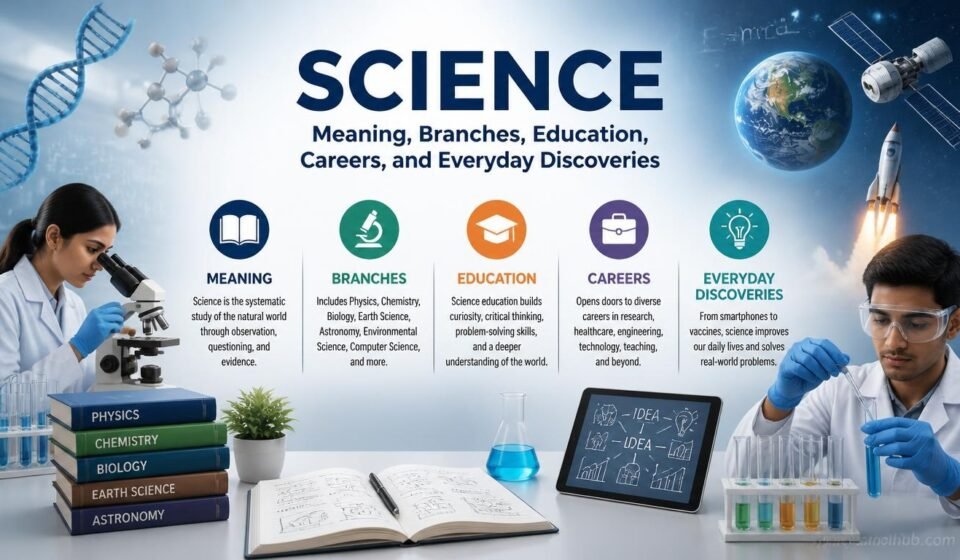

Science is one of the most important ways people understand the world around them. From discovering how the human body works to exploring distant planets, science helps us ask questions, investigate evidence, and develop explanations for natural events. It influences healthcare, education, technology, environmental protection, engineering, and almost every part of modern life.
The subject of science is much broader than laboratory experiments and school textbooks. It includes fields such as environmental science, physical science, forensic science, computer science, and data science. It also provides educational pathways ranging from school science curricula to associate degrees, bachelor’s degrees, and advanced research qualifications.
Whether you are a student choosing a subject, a parent exploring educational resources, or someone interested in scientific discoveries, understanding the different branches of science can help you make informed decisions.
What Is Science?
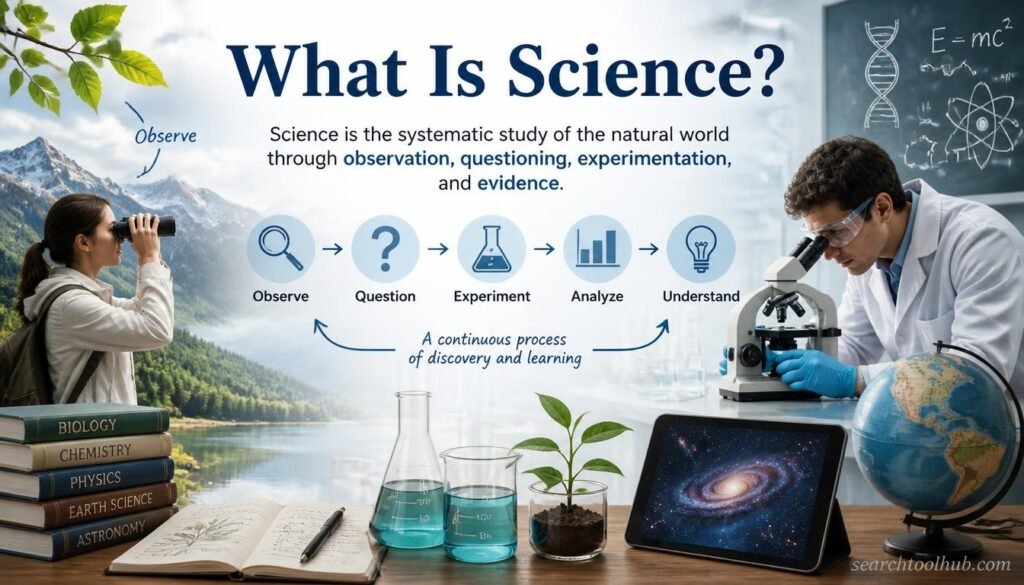
Science is the systematic study of the natural and physical world through observation, experimentation, measurement, and evidence. Scientists investigate questions, develop explanations, test ideas, and revise their conclusions when new evidence becomes available.
For example, a scientist studying rainfall may collect weather data, compare measurements across different locations, and investigate patterns. A medical researcher might investigate the effects of a treatment on the human body. Both use scientific methods, although their research questions are different.
Science is not simply a collection of facts. It is an ongoing process of investigation. Scientific explanations can become more accurate as technology improves and researchers discover additional evidence.
Why Is Science Important?
Science helps society in several important ways:
- Healthcare: Medical research supports the development of treatments, diagnostic methods, and disease-prevention strategies.
- Technology: Scientific discoveries contribute to computers, communication systems, transportation, and modern devices.
- Environmental protection: Researchers study climate, pollution, ecosystems, and biodiversity.
- Education: Science develops critical thinking, observation, problem-solving, and analytical skills.
- Agriculture: Scientific research improves crop production, soil management, and food safety.
- Public safety: Scientific testing helps identify hazards, investigate incidents, and evaluate risks.
Science is valuable because it encourages people to examine evidence instead of relying entirely on assumptions.
Main Branches of Science
Science includes many interconnected disciplines. Each branch focuses on particular questions, but discoveries in one field can often contribute to progress in another.
1. Physical Science
Physical science investigates non-living things, as well as the fundamental aspects of matter and energy. It often comprises physics and chemistry, as well as allied fields like astronomy and Earth science.
Physics investigates motion, forces, electricity, light, energy, and the structure of matter. Chemistry examines substances, their properties, and how they interact or change.
Students interested in engineering, materials research, energy, and technology often study physical science as part of their education.
2. Life Science
Life science investigates live organisms and biological processes. Biology, genetics, microbiology, ecology, and zoology are examples of subjects within this broad area.
Researchers use life science to understand how organisms grow, reproduce, adapt, and interact with their environments.
3. Environmental Science
Environmental science studies the natural environment and the relationships between humans, ecosystems, and natural resources.
It brings together knowledge from biology, chemistry, geology, geography, and other disciplines. Environmental scientists may investigate air pollution, water quality, climate patterns, soil conditions, conservation, and sustainable resource management.
Environmental science is especially important because communities around the world face challenges involving waste, changing weather patterns, habitat loss, and access to clean water.
For a deeper understanding, explore our detailed guide to
“Environmental Science: Meaning, Importance, Branches & Careers“
4. Forensic Science
Forensic science applies scientific methods to investigations involving legal questions. It can include laboratory analysis, biology, chemistry, toxicology, digital evidence examination, and other specialist disciplines.
Forensic professionals may examine evidence, document laboratory findings, and prepare reports that help investigators and courts understand scientific information.
The work requires accuracy, careful documentation, ethical conduct, and an understanding of the limitations of scientific testing. A forensic result should be interpreted in context rather than treated as automatic proof of an entire event.
Interested in how scientific methods support legal investigations? Read our detailed guide to “Forensic Science: Meaning, Branches, Courses & Careers“
5. Computer Science
The science of computing is the study of computation, algorithms, programming as well as software, thereby data formats, and computer systems.
It is closely connected to modern technology, including artificial intelligence, cybersecurity, mobile applications, and cloud computing.
A computer science education can prepare students for a range of technology-related careers. The exact opportunities depend on qualifications, practical skills, experience, and the requirements of employers.
6. Data Science
Data science combines statistics, mathematics, computing, and subject knowledge to extract useful information from data.
Data scientists may work with large datasets, identify patterns, build predictive models, and communicate findings to help organizations make decisions.
Applications include healthcare research, transportation planning, business analysis, environmental monitoring, and scientific research.
Science Education: From School to University
Science education usually begins with basic concepts such as plants, animals, matter, energy, the human body, weather, and the solar system. As students progress, they encounter more specialized subjects and learn how to conduct investigations.
A well-designed science curriculum should balance theoretical knowledge with practical understanding. Students should learn not only scientific definitions but also how to interpret evidence, evaluate claims, and explain their reasoning.
Science Curriculum in Schools
School science curricula vary by country, education board, district, and grade level. Some schools combine biology, chemistry, and physics in general science courses, while others introduce separate subjects as students advance.
Parents and students researching a particular school may encounter searches such as the Lebanon Borough school science curriculum PDF or the Lebanon Borough ELA literacy and science curriculum. These searches concern specific educational documents and should be checked against the relevant school’s official publications.
Similar questions arise when people research Northeastern US school districts’ core curriculum adoption for mathematics, science, and English language arts, or the Coventry School District in Vermont’s elementary mathematics, science, and ELA curriculum.
These are examples of local curriculum research, not universal science standards. The most reliable source for a school’s current curriculum is its official district website or published curriculum documentation.
Science Learning Resources and Online Study
Online learning platforms can help students review lessons, watch demonstrations, and practise scientific concepts. However, students should use educational tools to understand material rather than simply copy answers.
For example, someone searching for Edgenuity Earth Science answers may actually need help understanding topics such as rocks, weather, erosion, plate tectonics, or Earth’s systems. Reviewing the underlying lesson and working through practice questions is more useful for long-term learning than relying on answer collections.
Students can also explore educational journals, science magazines, school libraries, and research publications. A search for the National High School Journal of Science, for instance, reflects an interest in student-focused scientific writing and research opportunities. Readers should check publication details and editorial standards before relying on any journal.
Understanding Science Degrees
University science programs offer different qualifications depending on the subject, institution, and country. Before choosing a program, students should compare course content, entry requirements, accreditation, costs, and career pathways.
Associate of Science
An Associate of Science is generally an undergraduate qualification offered by certain colleges, particularly in the United States. It commonly takes around two years of full-time study, although the actual duration and structure vary.
The program may provide foundational education in mathematics, biology, chemistry, physics, or another scientific area. Some students use it as preparation for transferring into a bachelor’s degree program.
Bachelor of Science
A Bachelor of Science, often abbreviated as BS or BSc, is an undergraduate university degree focused on a particular academic or scientific discipline.
A Bachelor of Science may be awarded in biology, chemistry, physics, environmental science, computer science, mathematics, and many other subjects.
The phrase bachelor’s degree in science can refer to several different programs. Students should examine the actual degree title and course structure rather than assuming every Bachelor of Science has identical requirements.
Bachelor of Science in Computer Science
A Bachelor of Science in Computer Science typically covers programming, algorithms, software development, computer architecture, databases, and related technical subjects.
Students may also study artificial intelligence, cybersecurity, networks, or data science, depending on the university.
An online computer science degree can provide a flexible learning option for students who need to study remotely. However, applicants should check whether the institution is recognized, whether the qualification is accepted by employers, and whether the program includes practical projects.
Health and Nursing Science
Health science explores health, healthcare systems, human biology, disease prevention, and related subjects. Its programs may prepare students for different roles in healthcare, research, public health, or health administration.
A Bachelor of Science in Nursing is a professional nursing qualification in some education systems. Its requirements, clinical training, licensing process, and professional recognition depend on the country and relevant regulatory authority.
Students interested in healthcare should check the official requirements in the location where they intend to study and work.
Science Careers and Professional Opportunities
Science qualifications can lead to careers in research, healthcare, education, technology, environmental management, laboratories, and industry.
The right career depends on a person’s interests, education, experience, and professional requirements.
Some possible career directions include:
- Environmental scientist: Studies environmental conditions and supports conservation or resource-management projects.
- Forensic science professional: Applies scientific methods to evidence examination and laboratory analysis.
- Data analyst or data scientist: Uses data and analytical methods to identify patterns and communicate findings.
- Computer science professional: Works in software development, systems, computing, or related technology fields.
- Laboratory technician: Supports scientific testing, sample preparation, and laboratory operations.
- Research assistant: Helps researchers collect, organize, and analyze information.
- Science educator: Teaches scientific concepts and helps students develop investigative skills.
What Can You Do With Exercise Science Degree?
Exercise science focuses on physical activity, human movement, exercise physiology, and the body’s response to exercise.
Depending on the qualification and local professional requirements, graduates may explore opportunities in fitness education, wellness programs, sports support, exercise research, or further study in related healthcare fields.
Some clinical roles require additional professional education, registration, or licensing.
What Can You Do With a Health Science Degree?
A health science degree can serve as a basis for careers or additional study in public health, healthcare management, health research, community health, and related fields.
The available opportunities depend heavily on the program. A general health science qualification does not automatically qualify someone for every clinical profession.
Preparing a Science Curriculum Vitae
Students and professionals applying for research, laboratory, or academic opportunities may need a science curriculum vitae sample to understand how to present their qualifications.
A useful science CV generally includes:
- Contact information and a professional summary.
- Education and relevant qualifications.
- Research projects and laboratory experience.
- Technical and analytical skills.
- Publications, presentations, or academic awards, if applicable.
- Relevant work or volunteer experience.
- Professional references, when requested.
The information should be accurate and relevant to the opportunity. Applicants should never list research experience, publications, or qualifications they do not actually have.
Science Beyond the Classroom
Science is not limited to schools and universities. It can be explored through museums, outdoor activities, experiments, and community research.
Beach Science
Beach science is an accessible way to explore coastal environments. A visit to a beach can introduce people to geology, marine biology, oceanography, weather, and environmental science.
For example, observing different sand textures can raise questions about erosion and sediment movement. Studying shells can introduce marine biodiversity, while examining coastal litter can help explain pollution and conservation.
Beach observations should be conducted responsibly. Visitors should avoid disturbing wildlife, damaging habitats, or collecting protected natural materials.
Science Museums
Science museums make complex ideas easier to understand through interactive displays, demonstrations, historical objects, and educational exhibitions.
The Science Museum in London is a well-known example. It explores topics connected with scientific discoveries, engineering, medicine, technology, and industry.
Museums can be useful for students, families, teachers, and anyone interested in learning through practical demonstrations and historical context. Visitors should consult the museum’s official website for current exhibitions, opening arrangements, and visitor information.
Science Fiction and Scientific Imagination
Science fiction explores imagined technologies, future societies, space travel, artificial intelligence, and scientific possibilities.
Although fictional stories are not scientific evidence, they can encourage readers to think about real questions. For example, a story about space exploration may lead someone to research astronomy, while a fictional artificial intelligence system may inspire interest in computer science.
The important distinction is that science fiction uses imagination, whereas scientific research requires evidence and testing.
Sparks Science and Educational Activities
People searching for Sparks Science may be looking for a particular educational resource, program, or organization. Because the phrase can refer to different things, readers should verify the exact provider and its official materials.
In general, science activities that encourage observation, experimentation, and problem-solving can help learners develop a stronger understanding of scientific concepts.
Science in Different Countries and Learning Communities
Science education and research are international, but local educational systems differ.
For example, students searching for Class 10 Social Science in Assamese medium may be looking for school materials in Assam, India. Social science is related to the study of society, history, geography, economics, and civic life. Although it is different from natural science, both areas develop research, interpretation, and evidence-based reasoning.
Students should use learning materials that match their own education board, language, grade, and examination syllabus.
Similarly, students researching computer science programs should compare universities in their intended study destination. The best colleges for computer science are not necessarily the same for every student. Program quality, faculty, research opportunities, fees, scholarships, location, accreditation, and graduate outcomes all matter.
For students in Pakistan, checking the recognition of a university and its degree program through the relevant official education authorities is an important part of choosing a qualification.
How to Develop Strong Scientific Thinking
Anyone can improve their scientific thinking, even without access to a professional laboratory.
Start by asking clear questions. Instead of accepting a claim immediately, consider what evidence supports it and whether other explanations are possible.
Useful habits include:
- Observing carefully and recording information.
- Comparing evidence from reliable sources.
- Distinguishing facts from opinions.
- Understanding the difference between correlation and causation.
- Checking measurements and calculations.
- Recognizing uncertainty and limitations.
- Updating conclusions when stronger evidence becomes available.
These habits are useful in education, professional life, and everyday decisions.
The Future of Science
Scientific research continues to influence how societies respond to major challenges. Advances in artificial intelligence, biotechnology, renewable energy, medical research, robotics, and environmental monitoring are creating new opportunities and new questions.
Data science is helping researchers examine complex information. Computer science is supporting new forms of communication and automation. Environmental science is contributing to research on conservation and sustainable development.
Future progress will depend not only on new technology but also on responsible research, public education, collaboration, and ethical decision-making.
Conclusion
Science is a broad and evolving field that helps people understand nature, solve problems, and improve everyday life. Its branches range from physical and environmental science to forensic science, computer science, and data science. Its educational pathways include school curricula, associate qualifications, bachelor’s degrees, and specialized professional programs.
Whether you are exploring a science subject for school, comparing university degrees, visiting a museum, or considering a scientific career, the best starting point is curiosity supported by reliable information.
By asking questions, examining evidence, and continuing to learn, anyone can develop a better understanding of the scientific world.
Frequently Asked Questions About Science
1. What is science?
Science is the systematic study of the natural and physical world through observation, experimentation, measurement, and evidence. It helps people develop and test explanations about how things work.
2. What is environmental science?
Environmental science is the study of the environment and the relationships between living organisms, humans, and natural systems. It includes topics such as pollution, climate, ecosystems, conservation, and natural resources.
3. What is deposition in science?
Deposition is a process in which material settles or is laid down after being transported. In geology, it happens when sediment carried by water, wind, ice, or gravity is deposited in a new location. Deposition can contribute to the formation of layers of sediment and landforms.
4. What is forensic science?
Forensic science is the application of scientific methods to carry out legal investigations. It may require analyzing biological, chemical, physical, or digital evidence and communicating findings through scientific articles.
5. What is physical science?
Physical science is the study of nonliving systems, as well as the qualities of matter and energy. Its primary sections are physics and chemistry, with astronomy and Earth science being closely connected.
6. What do you do with an exercise science degree?
An exercise science degree can support careers or further study in fitness education, wellness, sports-related support, exercise research, and related fields. Some clinical professions require additional qualifications or licensing.
7. What exactly is the meaning of a Bachelor of Science in Nursing?
A Bachelor of Science in Nursing is an undergraduate nursing qualification in some countries. It generally combines nursing theory, health sciences, practical learning, and clinical education. Graduates must meet the applicable licensing or registration requirements to practise as nurses.
8. What can you do with a health science degree?
A health science degree may support opportunities in public health, health administration, research assistance, community health, and further healthcare education. Specific clinical careers may require additional professional qualifications.
9. What is a citizen science platform to sample beehive sounds for monitoring?
A citizen science platform for sampling beehive sounds would allow participants to collect or submit recordings of beehives for research. Researchers may study acoustic patterns to investigate colony activity and environmental conditions. Any such project should provide clear recording instructions, privacy information, and scientific guidance.
10. What is the definition of a constant variable in science?
A constant variable is a factor kept unchanged during an experiment so researchers can examine the effect of another variable. For example, when testing how light affects plant growth, researchers might keep the amount of water and type of soil constant.
11. Is psychology a social science?
Psychology is commonly classified as a social science because it studies human behavior and mental processes. It also uses methods from biology, neuroscience, statistics, and other scientific disciplines.
12. Is forensic science hard?
Forensic science can be challenging because it requires careful observation, scientific knowledge, accurate documentation, and attention to detail. Students may study biology, chemistry, laboratory methods, and legal procedures. The difficulty depends on the program and a student’s preparation and interests.
13. What can you do with an exercise science degree?
Graduates may explore fitness education, wellness services, exercise research, sports support, or additional study in related health fields. Professional requirements vary by role and location.
14. What is health science?
Health science is a broad field that studies human health, disease, healthcare, prevention, and related biological and social factors. It includes areas such as public health, health education, and healthcare research.
15. What can you do with a computer science degree?
A computer science degree can prepare graduates for roles in software development, systems analysis, programming, data-related work, cybersecurity, and other technology fields. Career options depend on practical skills, experience, and employer requirements.
16. What are the best colleges for computer science?
The best colleges for computer science depend on a student’s country, budget, academic background, and career goals. Compare accreditation, course content, faculty expertise, research opportunities, practical projects, graduate outcomes, and financial support before choosing a university.
17. What is the difference between science and social science?
Natural science studies the physical and biological world, while social science studies people, societies, institutions, and human behavior. Both use research methods and evidence, but they often investigate different types of questions.
18. Can science be studied online?
Yes. Many institutions offer online science courses and some offer complete online degrees. However, laboratory-based subjects may require practical sessions, supervised experiments, or in-person assessments. Students should check the program’s recognition and practical requirements before enrolling.
19. Why is science important for students?
Science helps students develop critical thinking, problem-solving, observation, research, and analytical skills. It also introduces them to subjects that can lead to further education and careers in healthcare, technology, engineering, research, and environmental work.
20. How can I learn science more effectively?
Start with the basic concepts, use reliable textbooks and educational resources, practise explaining ideas in your own words, and solve relevant questions. Diagrams, demonstrations, practical activities, and regular revision can make difficult topics easier to understand.