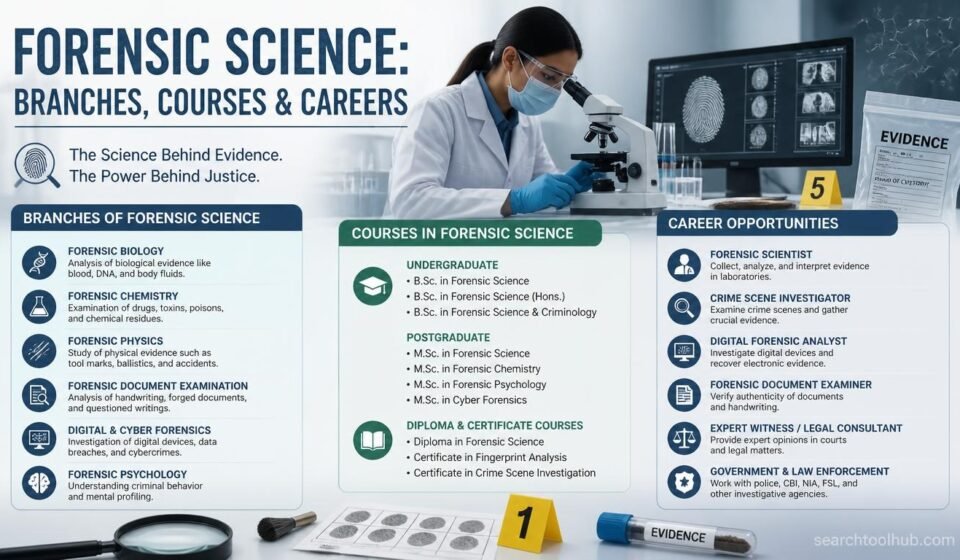

Forensic science plays an important role in modern investigations by using scientific methods to examine evidence and answer questions related to legal cases. From DNA analysis and fingerprint identification to toxicology and digital investigations, forensic science combines different scientific disciplines to help investigators understand what may have happened during an incident.
It connects subjects such as biology, chemistry, physics, medicine, computer science, and analytical research. Professionals working in this field examine evidence, perform laboratory tests, document findings, and prepare scientific reports that may be used during legal proceedings.
For a broader understanding of scientific subjects, explore our
“Science: Meaning, Branches, Education, Careers, and Everyday Discoveries“
For students interested in science, investigation, and laboratory research, forensic science can be an interesting area of education and professional development. However, the work requires patience, accuracy, ethical responsibility, and a strong understanding of scientific evidence.
This guide explains what forensic science is, its major branches, commonly used techniques, educational pathways, career opportunities, and the skills needed to enter this field.
What Is Forensic Science?
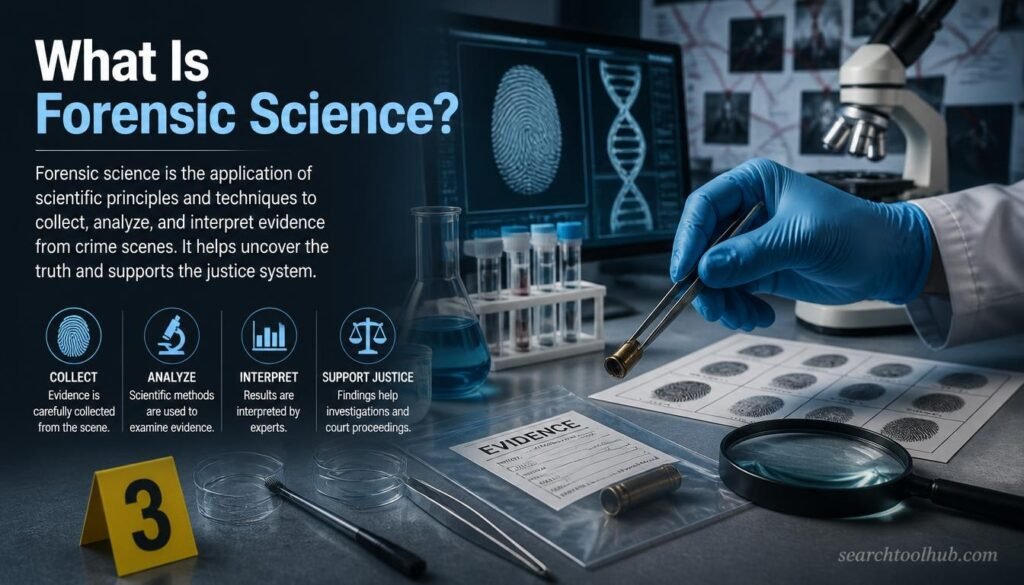
Forensic science is the application of scientific knowledge and processes to issues of law and investigation.
The word forensic is associated with courts and legal proceedings. Forensic professionals use scientific methods to examine physical, biological, chemical, and digital evidence.
For example, a forensic laboratory may examine a biological sample, compare fingerprints, identify a substance, or analyze information stored on a digital device.
The purpose is to produce reliable scientific findings that can help investigators and legal professionals understand evidence.
Forensic science does not automatically determine who is responsible for an incident. Instead, it provides information that must be interpreted alongside other evidence, investigative findings, and legal procedures.
Why Is Forensic Science Important?
Forensic science helps investigations become more evidence-based. It provides methods for examining information that may not be easily understood through ordinary observation.
Its importance includes several areas.
1. Scientific Examination of Evidence
Physical and biological materials can contain information relevant to an investigation. Scientific testing helps identify, classify, and examine these materials.
2. Supporting Criminal Investigations
Forensic findings may help investigators understand events, compare evidence, and evaluate different explanations.
3. Identifying Individuals
Certain forensic techniques, including DNA profiling and fingerprint comparison, can help establish or evaluate the identity of individuals under appropriate conditions.
4. Investigating Digital Evidence
Digital forensic specialists examine electronic information that may be relevant to an investigation, such as computer records, system activity, and digital documents.
5. Supporting Legal Proceedings
Forensic professionals may prepare technical reports and explain scientific findings in court. Their responsibility is to communicate what the evidence supports, including its limitations.
Main Branches of Forensic Science
Forensic science includes several specialized areas. Each focuses on a different type of evidence or scientific method.
1. Forensic Biology
Forensic biology examines biological materials that may be relevant to investigations.
Examples include:
- Blood samples
- Hair and tissue
- Saliva
- Other biological traces
- Biological material collected from objects or locations
Laboratory professionals may use biological testing to investigate the origin or characteristics of a sample.
2. Forensic DNA Analysis
DNA analysis is one of the most recognized techniques in forensic science.
DNA contains genetic information. Forensic laboratories can examine suitable biological samples and develop DNA profiles for comparison.
DNA evidence may help investigators assess whether a biological sample is consistent with a particular person’s profile.
However, interpretation requires care. Sample contamination, incomplete profiles, mixtures, and statistical uncertainty can affect results.
3. Forensic Chemistry
Forensic chemistry involves the chemical examination of materials connected with investigations.
Professionals may analyze unknown substances, chemical residues, paints, fibers, and other materials.
The methods used depend on the sample and the scientific question being investigated.
4. Forensic Toxicology
Forensic toxicology studies chemicals, drugs, alcohol, and other substances in biological samples.
It may be relevant in medical investigations, workplace incidents, and legal cases.
Toxicologists examine laboratory findings and consider factors such as substance concentration, timing, metabolism, and the limitations of available tests.
5. Fingerprint Examination
Fingerprint examination involves studying the patterns and features found on friction-ridge skin.
Fingerprints can be obtained from suitable surfaces and matched to reference records.
Examiners assess the quality of the available information and follow established procedures when making comparisons.
6. Digital Forensics
The field of digital forensics is concerned with the identification, preservation, examination, and reporting of information from digital devices and systems.
It may involve computers, storage media, mobile devices, and other electronic sources.
Digital forensic professionals must follow appropriate procedures to protect the integrity of evidence and maintain a clear record of how information was handled.
7. Forensic Anthropology
Forensic anthropology employs understanding of human skeleton biology to undertake legal investigations.
Specialists may examine human skeletal remains to help assess characteristics such as age-related features, biological variation, trauma, and other relevant findings.
This work generally requires advanced education and specialized training.
8. Forensic Entomology
Forensic entomology studies insects and their relationship to investigations.
In certain cases, insect development and environmental conditions may provide information relevant to estimating aspects of the postmortem interval.
Such estimates depend on several factors and should not be treated as exact measurements.
9. Forensic Ballistics
Forensic firearms examination involves the scientific examination of firearms, ammunition components, and related evidence.
Specialists may examine markings, cartridge cases, bullets, and other materials using established laboratory procedures.
The interpretation of these findings requires appropriate expertise and awareness of scientific limitations.
10. Forensic Document Examination
Forensic document examination focuses on questions involving documents, handwriting, signatures, printing, and alterations.
Examiners may assess whether documents have been modified or compare writing characteristics using appropriate methods.
Common Techniques Used in Forensic Science
Forensic laboratories use different analytical techniques depending on the evidence and the question being investigated.
DNA Profiling
DNA profiling examines selected genetic markers to develop a profile that can be compared with other suitable samples.
It is widely used in forensic investigations, subject to scientific standards and appropriate interpretation.
Chromatography
Chromatography is a scientific procedure that separates components in a mixture.
Different forms of chromatography are used in chemical analysis, pharmaceutical research, environmental testing, and forensic toxicology.
Microscopy
Microscopy allows professionals to examine materials that cannot be studied clearly with the naked eye.
It may be used to investigate fibers, particles, biological samples, and other small structures.
Spectroscopy
Spectroscopy involves studying how matter interacts with electromagnetic radiation.
It can help identify or characterize substances based on their measurable properties.
Fingerprint Comparison
Fingerprint comparison examines friction-ridge patterns and relevant features to assess similarities and differences between impressions.
Digital Evidence Analysis
Digital forensic methods can help examine files, records, system information, and other electronic evidence while maintaining appropriate procedures for preservation and documentation.
What Does a Forensic Scientist Do?
A forensic scientist examines evidence using scientific methods and communicates the results accurately.
Daily responsibilities depend on the specialist’s field and workplace.
Common responsibilities include:
- Receiving and documenting evidence.
- Maintaining proper sample identification.
- Following laboratory procedures.
- Conducting scientific tests.
- Recording measurements and observations.
- Analyzing results.
- Preparing technical reports.
- Explaining findings and limitations.
- Following ethical and professional standards.
A forensic scientist must remain objective. The purpose of the work is to examine evidence, not to support a preferred conclusion.
Forensic Science Courses and Education
Students interested in forensic science can explore different educational pathways.
The available qualifications depend on the country, university, and professional requirements.
Studying Forensic Science After School
Students may begin preparing through subjects such as biology, chemistry, mathematics, and physics.
These subjects provide a foundation for understanding laboratory methods and scientific principles.
Some universities offer dedicated forensic science undergraduate programs, while others provide forensic specializations within broader science degrees.
Bachelor’s Degree in Forensic Science
A bachelor’s degree in forensic science generally introduces students to scientific methods used in legal investigations.
Depending on the institution, subjects may include:
- Forensic biology
- Forensic chemistry
- Criminalistics
- DNA analysis
- Toxicology
- Evidence examination
- Laboratory techniques
- Research methods
- Legal and ethical principles
Course structures vary, so students should examine the official curriculum before applying.
Master’s Degree in Forensic Science
A master’s program may allow students to specialize in areas such as forensic biology, forensic chemistry, toxicology, digital forensics, or forensic research.
These programs often include advanced laboratory work, research projects, and specialized study.
Is a Science Background Necessary?
A science background is useful because forensic science depends on scientific knowledge.
Biology and chemistry are particularly relevant to several laboratory-based specialties. Digital forensics may require stronger knowledge of computing and information technology.
Students should check the entry requirements of their preferred universities because some programs accept different academic backgrounds.
Forensic Science Skills You Should Develop
Successful forensic work requires more than knowing how to operate laboratory equipment.
Important skills include:
Attention to Detail
Small mistakes in sample identification, documentation, or laboratory procedures can affect the reliability of findings.
Analytical Thinking
Professionals must evaluate results logically and understand what the evidence can and cannot demonstrate.
Scientific Communication
Forensic scientists need to explain technical findings clearly in reports and professional discussions.
Laboratory Skills
Many specialties require knowledge of laboratory equipment, measurement, sample handling, and quality-control procedures.
Ethical Responsibility
Forensic professionals must maintain impartiality, confidentiality, accuracy, and professional integrity.
Research Skills
Understanding scientific publications and evaluating research evidence helps professionals maintain reliable practices.
Forensic Science Career Opportunities
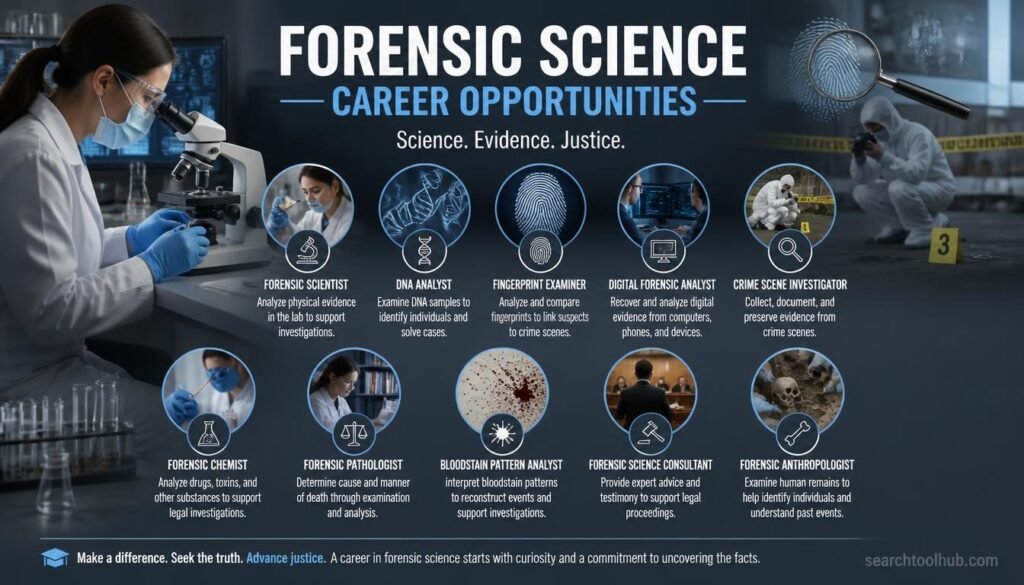
Forensic science offers different career directions depending on education, experience, and specialization.
Forensic Scientist
Forensic scientists examine evidence, conduct laboratory tests, and prepare reports.
They may specialize in biological, chemical, or other forms of forensic analysis.
Forensic Laboratory Technician
Laboratory technicians support scientific testing by preparing materials, maintaining equipment, documenting samples, and assisting qualified professionals.
DNA Analyst
DNA analysts examine biological samples and interpret genetic profiles using established laboratory procedures.
Forensic Toxicologist
Forensic toxicologists study the presence and effects of chemicals and other substances in biological samples.
Digital Forensic Analyst
Digital forensic analysts examine electronic information and help organizations or investigators understand relevant digital evidence.
Fingerprint Examiner
Fingerprint examiners study friction-ridge impressions and compare them using established procedures.
Forensic Researcher
Forensic researchers investigate scientific techniques, improve analytical methods, and evaluate the reliability of forensic practices.
Forensic Science Educator
Experienced professionals may teach forensic science, laboratory methods, and related subjects in educational institutions.
Some positions require postgraduate qualifications, professional training, certification, or relevant experience.
Where Do Forensic Scientists Work?
Forensic science professionals can work in different environments, depending on their specialization.
Common workplaces include:
- Government forensic laboratories
- Research institutions
- Universities and colleges
- Medical and diagnostic laboratories
- Digital investigation organizations
- Private analytical laboratories
- Scientific consulting organizations
Not every laboratory performs every type of forensic examination. Facilities usually have specific areas of expertise and operational requirements.
Forensic Science in Pakistan
Students in Pakistan who are interested in forensic science can explore relevant degree programs and scientific education opportunities through recognized universities and institutions.
Before choosing a program, check:
- Whether the institution is officially recognized.
- Whether the degree is appropriate for your intended career.
- Which subjects are included in the curriculum.
- Whether practical laboratory training is available.
- Whether internships or research opportunities are offered.
- What further qualifications may be required for professional roles.
For recognition and higher-education information, students should consult the Higher Education Commission of Pakistan and the official university websites.
Career opportunities may differ between public-sector laboratories, private organizations, academic institutions, and other employers.
Challenges and Limitations of Forensic Science
Although forensic science can provide valuable information, it has limitations.
Evidence Contamination
Improper handling can introduce unwanted material or damage evidence.
Incomplete Samples
Some samples may be too small, damaged, or unsuitable for reliable testing.
Interpretation Errors
Scientific results can be misunderstood if professionals do not consider the context, uncertainty, and limitations of a test.
Human Error
Documentation mistakes, incorrect procedures, and unsuitable comparisons can affect the quality of an examination.
Changing Scientific Standards
Scientific methods develop over time. Techniques must be evaluated and updated when stronger research or improved methods become available.
These challenges demonstrate why quality assurance, professional training, independent review, and transparent reporting are essential.
The Future of Forensic Science
Forensic studies and investigations are always evolving due to technological advancements.
Artificial Intelligence
Artificial intelligence may assist with certain image-analysis, pattern-recognition, and data-processing tasks. Its results still require appropriate human oversight and validation.
Advanced DNA Analysis
Research into genetic analysis continues to improve the ability to examine certain complex or limited biological samples.
Modern Digital Forensics
As more information is stored electronically, digital forensic professionals face new challenges involving cloud services, mobile devices, and evolving technologies.
Improved Laboratory Equipment
Advances in analytical instruments can support more precise measurements and improved examination methods.
Scientific Reliability and Ethics
The future of forensic science will depend not only on technology but also on reliable methods, professional standards, transparency, and responsible interpretation.
Conclusion
Forensic science is an important field that applies scientific knowledge to legal investigations. Its branches include forensic biology, DNA analysis, chemistry, toxicology, digital forensics, anthropology, and other specialized areas.
For students, it offers opportunities to study science and develop skills in research, laboratory work, analytical thinking, and professional communication. For society, it provides scientific methods that can help investigators and courts evaluate evidence.
Anyone considering this field should explore relevant degree programs, understand professional requirements, and develop a strong foundation in scientific principles.
The most important part of forensic science is not simply finding evidence. It is examining that evidence carefully, interpreting it responsibly, and communicating the findings accurately.
Frequently Asked Questions About Forensic Science
1. What is forensic science?
Forensic science is the application of scientific methods to carry out legal investigations. It entails assessing physical, biological, chemical, and digital evidence to assist in the resolution of disputes in investigations and court proceedings.
2. What are the main branches of forensic science?
The major branches are forensic biology, DNA analysis, forensic chemistry, toxicology, fingerprint examination, digital forensics, forensic anthropology, forensic entomology, and forensic document examination.
3. Is forensic science hard?
Forensic science can be challenging because it involves scientific subjects, laboratory procedures, analytical thinking, and detailed documentation. Biology and chemistry are important in many specialties. Students who enjoy research and careful investigation may find the subject rewarding.
4. What subjects are required for forensic science?
Biology, chemistry, mathematics, and physics can provide a useful academic foundation. Specific university entry requirements vary by institution and country.
5. How much time does it necessary to study forensic science?
A bachelor’s degree commonly takes around three to four years, depending on the country and university. Postgraduate qualifications require additional study. Program duration and structure should always be checked with the institution.
6. What does a forensic scientist do?
A forensic scientist examines evidence, performs scientific tests, analyzes results, maintains documentation, and prepares technical reports. Responsibilities vary according to specialization and workplace.
7. What is the difference between forensic science and criminology?
Forensic science applies scientific principles to evidence and legal issues. Criminology is the study of crime, criminal behavior, causes, and society reactions to crime. They are related but distinct academic disciplines.
8. Can I study forensic science after completing high school?
Yes. Many universities offer undergraduate forensic science programs or related science degrees. Admission requirements vary, so students should check the subjects, grades, and qualifications required by their chosen institution.
9. Is forensic science a good career?
Forensic science may suit people interested in scientific investigation, laboratory research, evidence analysis, and legal applications of science. Career opportunities depend on qualifications, specialization, location, and employer requirements.
10. Where can forensic scientists work?
They may work in government forensic laboratories, research institutions, universities, analytical laboratories, private organizations, and digital investigation teams.
11. What is DNA profiling in forensic science?
DNA profiling is a method of examining selected genetic markers to develop a DNA profile. Suitable profiles can be compared with other samples, although interpretation depends on sample quality and scientific context.
12. Can forensic science prove that someone is guilty?
Forensic evidence can provide information relevant to an investigation, but it does not automatically establish guilt. Evidence must be interpreted alongside other information and evaluated through the legal process.
13. What is digital forensic science?
Digital forensics involves identifying, preserving, examining, and reporting information from electronic devices and systems. It can include computers, storage devices, and other digital sources.
14. Is mathematics important in forensic science?
Mathematics and statistics are useful for measurements, data analysis, scientific calculations, and interpreting certain laboratory results. The level of mathematics required depends on the specialty and degree program.
15. What is the difference between forensic biology and forensic chemistry?
Forensic biology focuses on biological evidence such as DNA and other biological materials. Forensic chemistry examines substances and their chemical properties, including unknown materials and chemical residues.