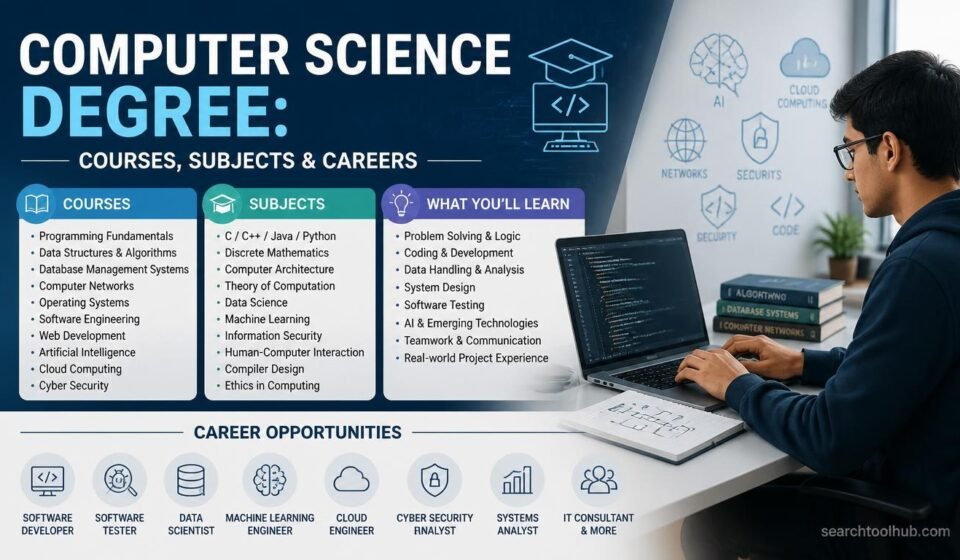

Technology has become an essential part of everyday life, from smartphones and websites to artificial intelligence, online banking, and business software. Behind many of these technologies are computer science professionals who design, develop, test, and improve digital systems. A computer science degree equips students with the information and practical skills required to comprehend how computers function and how software and technology solutions are developed.
A computer science degree is a popular choice for students interested in programming, problem-solving, software development, artificial intelligence, cybersecurity, and other technology-related fields. It combines theoretical concepts with practical learning, helping students understand both the foundations of computing and its real-world applications.
However, choosing a degree requires more than knowing that technology careers are in demand. Students should understand the subjects, admission requirements, available specializations, study options, and career opportunities before selecting a university program.
This guide explains what a computer science degree involves, what students learn, how long it takes, and which career paths may become available after graduation.
Computer science is one of the many fascinating areas of scientific study. Explore our Science: Meaning, Branches, Education, Careers, and Everyday Discoveries to understand the wider world of scientific knowledge.
What Is a Computer Science Degree?
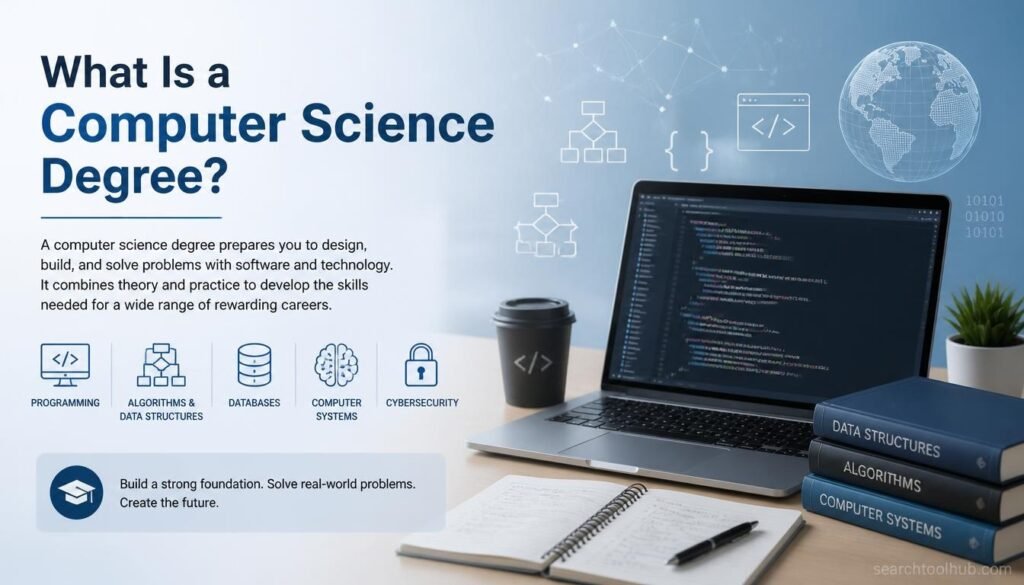
A computer science degree is an academic qualification focused on computing, programming, algorithms, software, data, and computer systems.
Students learn how computers process information, how software applications are developed, and how technology can solve complex problems.
The degree usually combines theoretical study with practical assignments, programming exercises, laboratory work, and projects. Depending on the university, students may also study advanced topics such as artificial intelligence, machine learning, cloud computing, cybersecurity, and data science.
Computer science encompasses more than just how to utilize a computer. It focuses on understanding the underlying concepts of computer technology and building solutions based on those ideas.
Why Study Computer Science?
Computer science can be a valuable academic choice for students who enjoy technology, logical thinking, creativity, and solving problems.
Here are some reasons students consider this field.
1. Learn Programming and Software Development
Students get a grasp of programming languages and learn how to design software programs, websites, and other digital solutions.
2. Explore Artificial Intelligence
Computer science provides a foundation for understanding artificial intelligence, machine learning, automation, and intelligent computer systems.
3. Develop Problem-Solving Skills
Programming and algorithm design encourage students to break complicated problems into smaller steps and develop logical solutions.
4. Understand Modern Technology
Students investigate the systems that power websites, mobile applications, databases, networks, operating systems, and digital services.
5. Explore Different Career Directions
Graduates may pursue careers in software development, data analysis, cybersecurity, systems engineering, research, and other technology-related areas.
6. Build Independent Projects
A computer science degree can prepare students to create their own programs, websites, software products, and technological initiatives.
Computer Science Degree Subjects
The exact curriculum varies by university and qualification, but most computer science programs include several foundational subjects.
1. Programming Fundamentals
Programming introduces pupils to the process of creating instructions that computers can follow.
Students can pick up languages like Python, Java, C, C++, or JavaScript, depending on the program.
Common topics include variables, conditions, loops, functions, data types, and basic problem-solving.
2. Data Structures and Algorithms
Data structures explain how information can be organized and stored efficiently.
Algorithms are step-by-step methods used to solve computational problems.
These subjects help students understand how to develop efficient programs and evaluate their performance.
3. Database Management Systems
Database courses introduce students to how digital information is stored, organized, retrieved, and managed.
Possible themes include relational databases, SQL, database architecture, data communication, and information security.
4. Computer Networks
Computer networking describes how computers and other devices connect.
Students may study network architecture, communication protocols, internet technologies, routing, and network security.
5. Operating Systems
Operating systems manage computer hardware as well as software capabilities.
Students learn about processes, memory management, file systems, scheduling, and how operating systems coordinate different computer activities.
6. Software Engineering
Software engineers are in charge of designing, developing, testing, maintaining, and improving software applications.
Students may learn about software development processes, project planning, requirement analysis, testing, and documentation.
7. Computer Architecture
Computer architecture explains the internal organization of computer systems.
Students may learn about processors, memory, input and output devices, instruction processing, and how hardware components work together.
8. Mathematics for Computer Science
Mathematics provides an important foundation for computing.
Common topics include discrete mathematics, logic, probability, statistics, linear algebra, and other mathematical concepts.
9. Artificial Intelligence
Some degree programs teach students about artificial intelligence and intelligent systems.
Topics may include machine learning, search algorithms, knowledge representation, and automated decision-making.
10. Cybersecurity
Cybersecurity courses teach how to safeguard computers, networks, software, and information against digital attacks.
Students may learn about access control, encryption concepts, secure programming, and risk management.
Types of Computer Science Degrees
Students can pick from a variety of academic qualifications based on their educational background and job objectives.
Associate Degree in Computer Science
An associate degree is a shorter undergraduate qualification offered by some educational institutions.
It may teach pupils programming, computer principles, databases, and basic software development.
Its availability and recognition depend on the country and education system.
Bachelor’s Degree in Computer Science
A bachelor’s degree is a popular undergraduate option for those interested in professional computer professions.
Programs often take around three to four years, depending on the country, university, and course structure.
Students generally study core computing subjects before selecting electives or specialization areas.
Master’s Degree in Computer Science
A master’s degree provides advanced study in computer science.
Students might focus on artificial intelligence, cybersecurity, software engineering, data science, computer networks, and other topics.
Admission commonly requires a relevant undergraduate qualification, although university requirements differ.
PhD in Computer Science
A PhD is a research-focused qualification for students interested in advanced academic or scientific work.
Doctoral students investigate specific research questions, develop new approaches, and contribute to knowledge in a computing-related field.
Computer Science Degree Admission Requirements
Admission requirements vary between universities and countries.
For undergraduate programs, institutions commonly consider:
- Completion of secondary or higher-secondary education.
- Required academic grades or examination results.
- Mathematics or other relevant subjects.
- Entrance examinations, where applicable.
- English-language requirements for certain programs.
- Additional university-specific admission conditions.
For postgraduate programs, students may need a relevant bachelor’s degree, academic transcripts, research experience, or other qualifications.
Before applying, students should review the official admission criteria of each university rather than relying on general information.
Computer Science Degree in Pakistan
Students in Pakistan can explore computer science programs offered by universities and recognized higher-education institutions.
A common undergraduate route is a BS Computer Science program, although program names and structures can differ.
Students should carefully check:
- Whether the university is recognized by the Higher Education Commission of Pakistan.
- Whether the specific campus and degree program meet applicable recognition requirements.
- The mathematics and academic requirements for admission.
- The curriculum and available specializations.
- Laboratory facilities and practical learning opportunities.
- Internship, research, and final-year project options.
A strong program should provide a balance of computing fundamentals, practical programming, software development, and opportunities to work on real projects.
Students should also consider the university’s teaching quality, learning environment, facilities, and overall costs when making a decision.
Online Computer Science Degree Programs
Online computer science degrees allow students to study computing through digital learning platforms.
Depending on the institution, students may attend live classes, watch recorded lectures, complete programming assignments, participate in online discussions, and submit projects.
Benefits of Online Study
- Flexible study schedules.
- Access to learning materials from different locations.
- Opportunities to balance education with other responsibilities.
- Access to some international academic programs.
- Reduced need for daily travel.
Challenges of Online Study
- Students need good time-management skills.
- Practical laboratory access may be limited.
- Reliable internet access is important.
- Some programs provide less direct interaction with instructors.
- Accreditation and degree recognition must be checked carefully.
Before enrolling, students should verify the institution, qualification, assessment methods, student support, and recognition of the online degree.
Computer Science Specializations
After learning the fundamentals, students may choose an area that matches their interests.
Artificial Intelligence and Machine Learning
This specialization focuses on developing computer systems that perform tasks involving learning, prediction, and intelligent decision-making.
Cybersecurity
Cybersecurity is concerned with preserving digital systems, software, networks, and data.
Data Science
Data science combines computing, statistics, and analytical methods to extract useful information from data.
Software Engineering
The basic purpose of software engineering is to design and maintain reliable applications and software systems.
Web Development
Web development include creating websites and web-based applications with programming languages, frameworks, and other tools.
Cloud Computing
Cloud computing focuses on delivering computing resources and digital services through network-based infrastructure.
Computer Networks
This area explores how devices, servers, and systems communicate and exchange information.
Human-Computer Interaction
Human-computer interaction studies how people use digital systems and how technology can be designed to provide better user experiences.
Career Opportunities After a Computer Science Degree

A computer science degree can provide a foundation for several technology-related careers.
The qualifications required for each role depend on the employer, location, experience, and technical specialization.
1. Software Developer
Software developers create, construct, test, and maintain programs.
They may work on desktop programs, business systems, mobile applications, or web-based products.
2. Web Developer
Web developers build and manage websites and web applications.
They may specialize in frontend development, backend development, or full-stack development.
3. Data Analyst
Data analysts examine information, identify patterns, and prepare reports that support business or research decisions.
4. Cybersecurity Analyst
Cybersecurity analysts help organizations monitor digital systems, identify security risks, and improve protection against cyber threats.
5. Database Administrator
Database administrators manage database systems and help maintain the availability, organization, security, and performance of stored information.
6. Systems Analyst
Systems analysts study organizational technology requirements and help develop or improve computer-based systems.
7. Artificial Intelligence Engineer
AI engineers work on systems that use machine learning and other artificial intelligence techniques.
These positions often require additional practical experience and specialized knowledge.
8. Mobile Application Developer
Mobile developers create applications for smartphones and tablets using suitable development languages and platforms.
9. Cloud Engineer
Cloud engineers work with cloud infrastructure, computing services, deployment systems, and related technologies.
10. Researcher or Academic
Graduates interested in advanced study may pursue research, teaching, or academic careers after obtaining the necessary qualifications.
Skills to Develop During a Computer Science Degree
A degree provides academic knowledge, but students also need practical skills to prepare for professional work.
Important skills include:
Programming: Learn at least one programming language thoroughly before moving into several others.
Logical thinking: Practice breaking complex problems into manageable steps.
Problem-solving: Work on coding exercises and real-world programming challenges.
Communication: Learn to explain technical concepts clearly and work effectively with others.
Teamwork: Take part in group initiatives and collaborative growth.
Research: Learn how to read technical documentation and evaluate different solutions.
Adaptability: Technology changes regularly, so continuous learning is important.
Project development: Build applications and other practical projects that demonstrate your abilities.
How to Prepare Before Starting a Computer Science Degree
Students do not need to become expert programmers before university, but some preparation can make the beginning of a degree easier.
Consider these steps:
- Learn basic computer operations and file management.
- Start programming with a beginner-friendly language such as Python.
- Practice basic mathematics and logical reasoning.
- Understand simple concepts such as variables, conditions, and loops.
- Explore how websites and applications work.
- Practice solving small programming problems.
- Read introductory material about algorithms and databases.
- Build a simple project to apply what you have learned.
Consistency is more useful than trying to learn every technology at once.
Is a Computer Science Degree Worth It?
A computer science degree can be worthwhile for students who want a structured education in computing and access to academic, research, or professional opportunities.
It provides a foundation in programming, algorithms, computer systems, software development, and related disciplines.
However, a degree alone does not guarantee employment or professional success.
Students should combine academic study with practical projects, internships where available, technical communication, and continuous learning.
People interested in technology should also consider their learning preferences. Some may prefer a traditional university program, while others may begin with independent study or shorter courses before choosing a degree.
The best pathway depends on individual goals, available resources, and the requirements of the intended career.
The Future of Computer Science
Computer science continues to develop as technology becomes more integrated into business, education, healthcare, communication, and everyday activities.
Several areas are attracting attention.
Artificial Intelligence
Artificial intelligence is affecting software development, research, automation, and information processing. Computer science education enables experts to comprehend how these systems are built and assessed.
Cloud and Distributed Computing
Modern digital services often rely on systems that operate across multiple servers and locations. These technologies create opportunities in infrastructure and software engineering.
Cybersecurity
As organizations depend more heavily on digital systems, protecting information and infrastructure remains an important technical challenge.
Data and Analytics
Businesses and research organizations use data to understand trends, evaluate performance, and support decisions.
Robotics and Automation
Computing is an important part of robotics, industrial automation, and intelligent machines.
The future of the field will require both strong technical foundations and the ability to adapt to new developments.
Conclusion
A computer science degree provides a foundation for understanding computers, programming, software development, algorithms, data, and modern technology.
Students can explore different subjects and specializations, including artificial intelligence, cybersecurity, data science, software engineering, and computer networks.
The qualification can lead to several career directions, but professional success also depends on practical experience, problem-solving ability, continuous learning, and the quality of the education received.
Before selecting a program, compare university recognition, admission requirements, course content, practical training, and career opportunities.
For students who enjoy technology and analytical thinking, computer science can be a meaningful path toward understanding and creating the digital systems used around the world.
Frequently Asked Questions About Computer Science Degrees

1. What is a computer science degree?
A computer science degree is an academic qualification that teaches students about programming, algorithms, computer systems, software development, databases, and other computing technologies.
2. How many years does a computer science degree take?
A bachelor’s degree commonly takes three to four years, depending on the country and university. Master’s and doctoral qualifications require additional study.
3. Is computer science difficult to study?
Computer science can be challenging because it involves programming, mathematics, logical reasoning, and problem-solving. Regular practice and a strong foundation in basic concepts can make learning easier.
4. What subjects are required for computer science?
Mathematics is important for many computer science programs. Universities may also consider other academic subjects and examination results. Specific requirements vary by institution.
5. Can I study computer science without programming experience?
Yes. Many undergraduate programs introduce programming from the beginning. Learning basic programming before starting can still be helpful.
6. What can I do after a computer science degree?
Graduates may pursue roles such as software developer, web developer, data analyst, cybersecurity analyst, systems analyst, database administrator, or other computing-related positions.
7. Is a computer science degree useful in Pakistan?
It can provide a foundation for technology-related careers and further study. Students should choose a recognized institution and develop practical skills alongside their academic education.
8. Can I get a computer science degree online?
Yes. Some recognized institutions offer online computer science programs. Students should verify accreditation, recognition, curriculum, assessment methods, and practical learning opportunities before enrolling.
9. What is the distinction between computer science and information technology?
Computer science focuses on computing principles, programming, algorithms, and software systems. Information technology generally focuses more on using, managing, supporting, and maintaining technology within organizations.
10. Which programming language should computer science beginners learn?
Python is a common starting point because its syntax is relatively accessible. Other languages, including Java, C, C++, and JavaScript, may be introduced depending on the program.
11. Does computer science require mathematics?
Yes, mathematics is an essential component of many computer science curricula. Discrete mathematics, statistics, logic, and linear algebra are all useful topics in many fields of computing.
12. Can computer science graduates work remotely?
Some computer science-related roles offer remote or hybrid working opportunities. Availability depends on the job, employer, experience, and location.
13. Is computer science the same as software engineering?
No. They are closely related but have different areas of emphasis. Computer science covers broader computing principles, while software engineering focuses more specifically on the structured design, development, testing, and maintenance of software.
14. What is the distinction between BS Computer Science and a BS Software Engineering?
A BS Computer Science generally covers a broad range of computing topics, including algorithms, systems, programming, and theory. A BS Software Engineering usually places greater emphasis on software development processes, requirements, testing, and project management. Actual curricula vary by university.
15. What should I look for when choosing a computer science university?
Consider institutional recognition, curriculum quality, faculty experience, laboratory facilities, practical projects, internships, student support, and available specialization options.