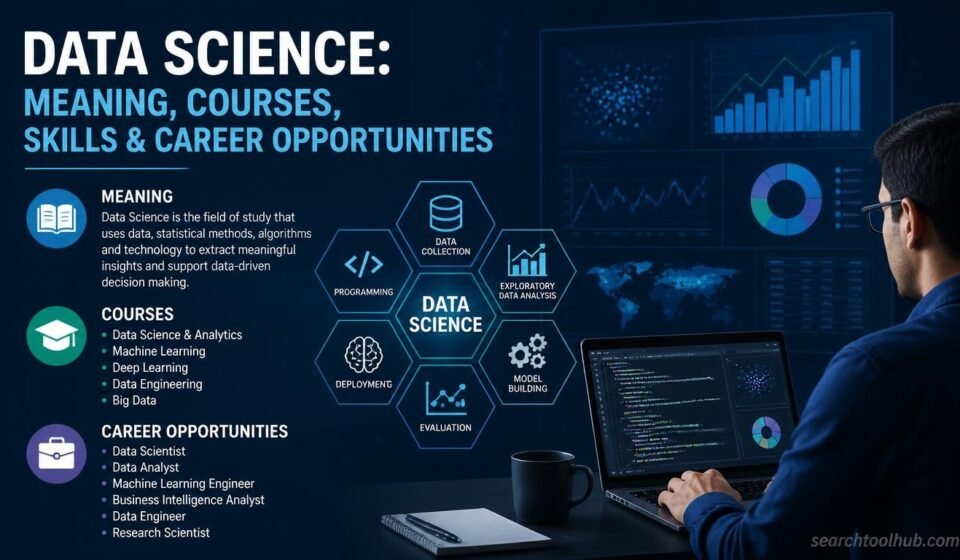

Every day, businesses, schools, hospitals, banks, and online platforms generate enormous amounts of information. A shopping website records customer activity, a hospital maintains patient records, and a bank monitors thousands of transactions. However, collecting information is only the beginning. The real challenge is understanding what that information means and using it to make better decisions.
This is where data science becomes important. It combines mathematics, statistics, programming, and analytical thinking to turn raw information into useful knowledge. Data science helps organizations recognize patterns, investigate problems, understand behavior, and make decisions based on evidence rather than assumptions.
For students interested in technology, mathematics, research, and problem-solving, data science offers an opportunity to work with information in practical ways. It is also connected to several growing areas of computing, including artificial intelligence, machine learning, business analytics, and data engineering.
This guide explains what data science means, how the process works, what students study in a data science degree, which technical skills are useful, and what career opportunities may be available after graduation.
Data science is one of the many modern fields connected to scientific research and technological development. Explore our Science: Meaning, Branches, Education, Careers, and Everyday Discoveries to discover more scientific subjects.
What Is Data Science?
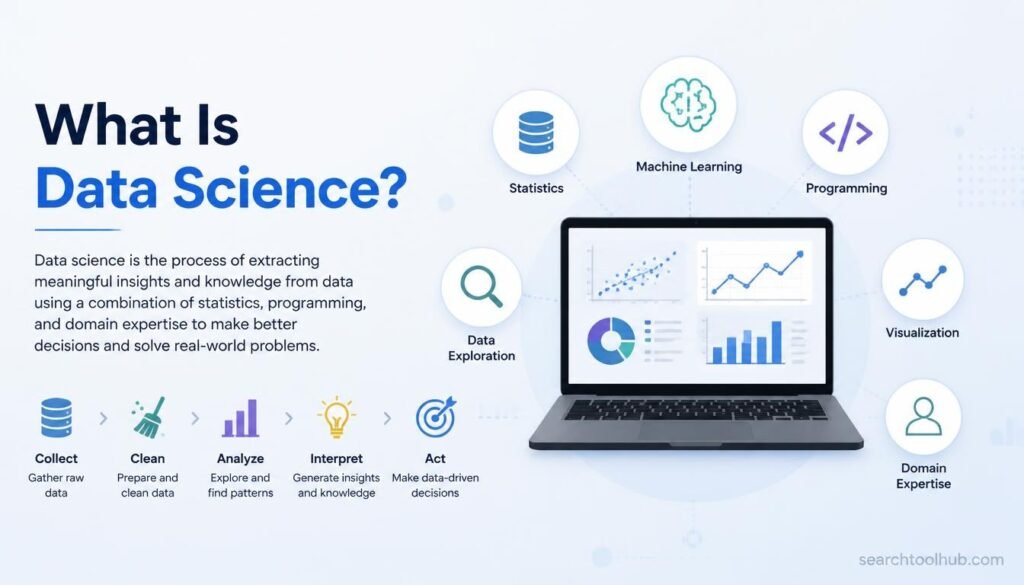
Data science is an interdisciplinary field that uses scientific methods, statistics, programming, and analytical techniques to extract meaningful information from data.
Data can come from many sources, including websites, mobile applications, surveys, business transactions, scientific experiments, sensors, and public records.
A data scientist or analyst studies this information to answer questions and identify useful patterns.
For example, an online store may want to understand why customers leave without completing a purchase. A data science team can examine website activity, product information, customer interactions, and purchasing records to identify possible reasons.
The results may help the business improve its website or make its services more useful.
Data science is not simply about creating charts or collecting statistics. It involves asking the right questions, preparing information, selecting suitable methods, checking results, and communicating findings clearly.
How Does Data Science Work?
A data science project usually follows a series of connected stages. The exact process depends on the problem, the available information, and the methods being used.
1. Understanding the Problem
Every useful project begins with a clear question.
A company might want to reduce delivery delays, a university might want to understand student performance, or a researcher might want to examine environmental changes.
The objective helps determine what information is needed and how success will be measured.
2. Collecting Data
Obtaining pertinent data from reliable sources is the next stage.
Data may come from:
- Business databases
- Online surveys
- Public datasets
- Scientific experiments
- Application records
- Sensors and connected devices
- Customer feedback
The quality and suitability of the collected information can strongly influence the final results.
3. Cleaning and Preparing Data
Incorrect entries, duplicate records, inconsistent formats, and missing values are common in raw data.
Before analysis, these problems need to be investigated and handled appropriately.
For example, a customer database may contain the same person multiple times or utilize different date formats. Data preparation makes information more consistent and acceptable for analysis.
4. Exploring the Information
Exploratory data analysis helps researchers understand the information before building more advanced models.
They may examine averages, distributions, relationships, unusual values, and changes over time.
Charts and statistical summaries can make patterns easier to recognize.
5. Applying Statistical and Computational Methods
Depending on the project, professionals may use statistical analysis, mathematical models, or machine learning techniques.
These methods can help identify relationships, classify information, estimate future values, or group similar observations.
The method should match the research question rather than being selected simply because it is popular.
6. Evaluating Results
An analytical result is not automatically reliable.
Professionals need to check whether the method works correctly, whether the available data is suitable, and whether the findings are affected by bias or other limitations.
For predictive models, evaluation may involve testing performance on data that was not used to train the model.
7. Communicating Findings
The final stage is explaining what the analysis means.
Reports, dashboards, presentations, and visualizations help decision-makers understand the findings and consider appropriate actions.
A good data science project should produce understandable and useful conclusions, not just complicated calculations.
Real-World Applications of Data Science
Data science is used in many industries because organizations need ways to understand information and improve their operations.
1. Healthcare
Healthcare organizations can use data analysis to study patient records, hospital operations, medical research, and public health trends.
Researchers may examine large datasets to investigate relationships between different factors.
The responsible use of health information requires strong privacy protections and careful interpretation.
2. Banking and Finance
Financial institutions analyze transaction information, customer activity, and market data.
Data-driven systems may help identify unusual transaction patterns, assess certain risks, and improve operational decisions.
3. Education
Schools and universities can examine attendance, assessment results, course participation, and student feedback.
This information may help educators identify areas where students need additional academic support.
4. E-Commerce
Online retailers study product views, purchases, customer preferences, and shopping patterns.
Analysis can help businesses improve product recommendations, understand customer demand, and plan inventory.
5. Transportation
Transport organizations may use information about traffic, routes, delivery schedules, and vehicle performance.
Data analysis can support route planning, demand estimation, and operational improvements.
6. Agriculture
Agricultural researchers and businesses can analyze weather information, soil measurements, crop records, and irrigation data.
These findings may help farmers and researchers understand growing conditions and make more informed decisions.
7. Environmental Research
Environmental scientists use data to examine temperature records, air quality, rainfall, water conditions, and changes in ecosystems.
This creates a connection between data science and environmental science, where analytical methods can support research into environmental problems.
8. Sports
Sports organizations can analyze player statistics, training records, match performance, and team strategies.
These insights may help coaches and analysts evaluate performance and plan improvements.
Data Science vs. Data Analytics vs. Data Analysis
These terms are related, but they do not always mean exactly the same thing.
In general, data analysis is the process of reviewing information to answer a specific issue. It may include calculations, comparisons, graphs, and statistical procedures.
Data analytics is often used to describe the broader practice of analyzing information to identify trends and support decisions. It can include reporting, business intelligence, and predictive techniques.
Data science covers a wider combination of scientific methods, programming, statistical reasoning, and computational techniques. It may include building predictive models and developing systems that work with complex datasets.
The boundaries between these fields can overlap. Different organizations also use job titles and responsibilities differently.
Data Science vs. Computer Science
Data science and computer science are closely connected, but their main areas of emphasis are different.
Computer science studies computing principles, programming, algorithms, software, and computer systems.
Data science focuses on extracting useful knowledge from information through statistics, mathematics, programming, and analytical methods.
For example, a computer scientist may develop the software infrastructure used to store and process information, while a data scientist may use that information to investigate patterns or build a predictive model.
Both fields require logical thinking and technical knowledge. Some universities offer separate degree programs, while others provide data science as a specialization within computer science.
Important Data Science Courses and Subjects
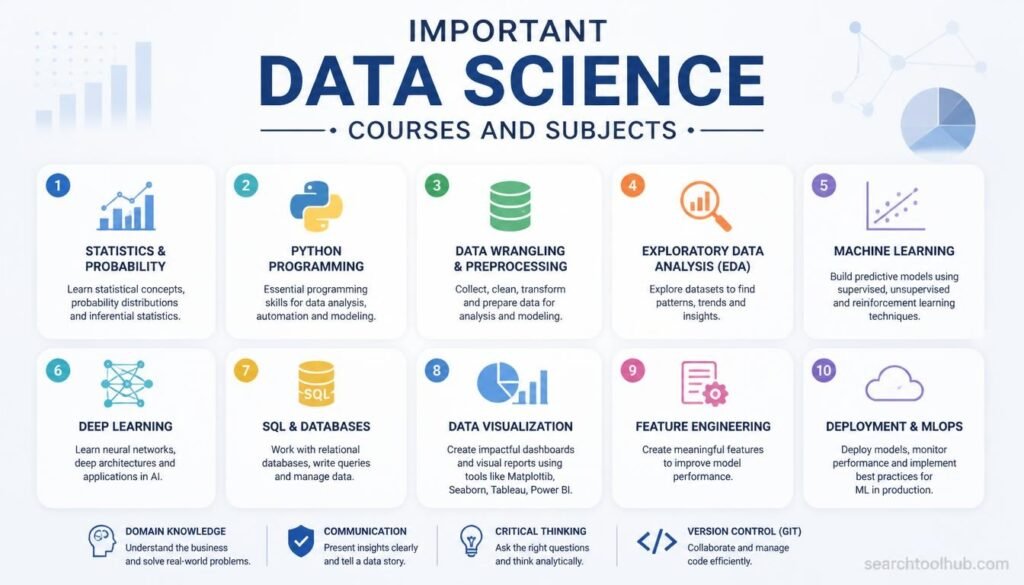
A data science degree combines computing with mathematics and statistics. The curriculum varies between universities, but students commonly encounter the following subjects.
1. Programming Fundamentals
Programming teaches students how to write instructions, process information, and develop computational solutions.
Python is widely used in data-related work because it has a large collection of libraries for data preparation, analysis, visualization, and machine learning.
Some programs also introduce other languages.
2. Probability and Statistics
Statistics helps students understand data, measure uncertainty, compare observations, and evaluate relationships.
Probability provides a mathematical framework for reasoning about uncertain events.
These subjects are especially important when interpreting research results and evaluating predictive models.
3. Mathematics and Linear Algebra
Mathematics supports many computational and analytical techniques.
Linear algebra is particularly relevant to machine learning, numerical methods, and the representation of complex datasets.
4. Database Systems
Data science projects often require information stored in structured databases.
Students will study how data is organized, retrieved, updated, and managed. SQL is often used to work with relational databases.
5. Data Structures and Algorithms
These subjects explain how information can be stored and processed efficiently.
Students learn to choose suitable approaches for computational problems and understand how different methods affect performance.
6. Data Mining
Data mining is the process of analyzing massive databases to discover interesting patterns, correlations, and structures.
It can be used in research, business analysis, and other information-intensive applications.
7. Machine Learning
Machine learning studies methods that allow computer systems to identify patterns from data and use them to make predictions or classifications.
Students may learn about training data, model evaluation, classification, regression, and clustering.
8. Data Visualization
Data visualization involves presenting information through charts, graphs, maps, and dashboards.
Students learn how to communicate results clearly without misleading the audience.
9. Data Engineering Fundamentals
Data engineering focuses on preparing, moving, storing, and managing information so that it can be used by analytical systems.
Students may explore data pipelines, data warehouses, and processing technologies.
10. Research Methods and Ethics
Students learn how to investigate questions systematically, evaluate evidence, and communicate results.
Ethics is also important because datasets can contain personal, confidential, or sensitive information.
Essential Data Science Tools and Technologies
Data science professionals use different tools depending on their projects and specialization.
Python
Python is a popular programming language for data preparation, statistical work, visualization, and machine learning.
Common libraries include Pandas, NumPy, and Scikit-learn.
R
R is a programming language widely used for statistical computing, data analysis, and research.
SQL
SQL is used to retrieve and manage information stored in relational database systems.
Microsoft Excel
Excel can help with organizing smaller datasets, calculations, basic analysis, and reporting.
Power BI and Tableau
These tools support data visualization, interactive dashboards, and business reporting.
Jupyter Notebook
Jupyter Notebook provides an environment for combining code, explanations, calculations, and visualizations in one document.
Cloud Platforms
Cloud services provide computing and storage resources that can support large-scale data projects.
Students may encounter platforms such as Microsoft Azure, Amazon Web Services, and Google Cloud during advanced study or professional training.
Learning every tool is not necessary at the beginning. It is more useful to understand the underlying concepts and become comfortable with a few relevant technologies.
Data Science Degree: Duration and Study Options
A data science degree can be offered as an undergraduate qualification, a postgraduate program, or a specialization within another computing degree.
A bachelor’s program commonly takes around four years in many universities using an eight-semester structure. Actual duration and credit requirements depend on the institution and education system.
Students may also enter the field through related degrees such as computer science, statistics, mathematics, information technology, or engineering, followed by specialized training.
Bachelor’s Degree in Data Science
An undergraduate degree generally introduces students to programming, mathematics, statistics, databases, data analysis, and machine learning.
It may also include practical laboratory work, internships, research assignments, and a final-year project.
Master’s Degree in Data Science
A master’s program offers more advanced study for graduates who want to develop specialized analytical or computational knowledge.
Possible areas include advanced analytics, machine learning, artificial intelligence, business intelligence, and data engineering.
Online Data Science Courses and Degrees
Online learning can help students develop technical skills through recorded lessons, interactive exercises, programming assignments, and projects.
Some institutions also offer complete online academic qualifications.
Before enrolling in an online degree, check the institution’s recognition, course structure, assessment methods, and practical learning opportunities.
Studying Data Science in Pakistan
Students in Pakistan can explore dedicated BS Data Science programs and related computing degrees at universities offering relevant courses.
For example, Sindh Madressatul Islam University publishes a BS Data Science structure with eight semesters and 130 credit hours. Virtual University of Pakistan also publishes a BS Data Science study scheme with eight semesters and a four-year duration. Program structures can differ between institutions and admission sessions.
Before choosing a university, students should check:
- Recognition of the institution and program requirements.
- Current admission eligibility and mathematics requirements.
- Programming, statistics, and mathematics courses.
- Practical laboratory and project opportunities.
- Internship or industry exposure.
- Available specialization and postgraduate pathways.
The Higher Education Commission of Pakistan and relevant accreditation bodies provide information students can use when checking educational recognition.
It is also useful to compare the actual curriculum rather than choosing a program based only on its name.
Data Science Career Opportunities
A data science qualification can provide a foundation for different roles involving information, programming, statistics, and analytical problem-solving.
The exact requirements depend on the employer, location, experience, and specialization.
1. Data Analyst
A data analyst examines datasets, prepares reports, identifies trends, and communicates findings.
This role often involves spreadsheets, SQL, visualization tools, and statistical methods.
2. Data Scientist
Data scientists investigate complex questions using programming, statistics, and computational techniques.
They may develop predictive models, conduct experiments, and explain analytical results.
3. Business Intelligence Analyst
Business intelligence analysts transform business information into reports and dashboards that help organizations monitor performance and make decisions.
4. Machine Learning Engineer
Machine learning engineers develop and maintain systems that use machine learning models.
This role often requires programming, software engineering, model evaluation, and deployment knowledge.
5. Data Engineer
Data engineers build and maintain systems that collect, transform, store, and deliver information for other applications and analytical teams.
6. Research Analyst
Research analysts examine information to answer questions in business, education, science, public policy, or other fields.
7. Database Developer
Database developers design and maintain database structures and support applications that depend on organized information.
8. Data Visualization Specialist
These professionals focus on presenting complex information in understandable visual formats, including dashboards, reports, and interactive charts.
Skills Needed to Become a Data Scientist
A successful data science professional needs a combination of technical knowledge and communication skills.
Programming: Learn Python or another suitable language and practice working with real datasets.
Statistics: Understand averages, distributions, probability, relationships, and uncertainty.
Mathematical reasoning: Develop a foundation in algebra, calculus, and linear algebra where relevant.
Data preparation: Learn how to identify missing values, inconsistent records, and other data-quality problems.
Critical thinking: Question assumptions and avoid accepting analytical results without evaluation.
Communication: Explain findings in a way that people without technical backgrounds can understand.
Problem-solving: Convert broad questions into smaller, testable tasks.
Ethical awareness: Respect privacy, data ownership, and responsible use of information.
How to Start Learning Data Science as a Beginner
You do not need to master advanced mathematics or machine learning before starting. A gradual learning plan can help you develop the required foundation.
- Learn basic computer operations and file management.
- Study introductory mathematics and statistics.
- Start programming with Python.
- Practice using spreadsheets to organize information.
- Learn basic SQL and database concepts.
- Explore simple datasets and create charts.
- Practice cleaning and preparing information.
- Build small projects that answer clear questions.
- Learn introductory machine learning after understanding the basics.
- Document your projects in a portfolio.
A beginner project could involve analyzing public weather records, comparing product prices, studying a survey, or examining a dataset about transportation.
The goal is to learn how to ask a question, work with appropriate information, select a suitable method, and explain the result.
Challenges and Limitations of Data Science
Although data science can provide useful insights, it also involves important challenges.
Poor Data Quality
Missing, inaccurate, outdated, or inconsistent information can reduce the reliability of an analysis.
Data Privacy
Personal information must be handled responsibly. Organizations need suitable safeguards and should follow applicable privacy laws.
Bias in Data
A dataset may not represent every group or situation equally. If this problem is ignored, an analytical model can produce unfair or misleading results.
Incorrect Interpretation
A relationship between two variables does not automatically prove that one causes the other.
Model Reliability
Predictive models may perform poorly when they encounter information that differs significantly from their training data.
Communication Problems
Even technically correct analysis can be misunderstood if the findings are presented without context or explanation.
Good data science requires transparency, validation, and awareness of uncertainty.
The Future of Data Science
Data science continues to develop as organizations collect and process information from more sources.
Artificial intelligence is expanding the ways information can be analyzed, while cloud computing provides infrastructure for increasingly complex projects.
Other areas of development include automated data preparation, real-time analytics, privacy-aware computation, and improved methods for evaluating machine learning systems.
However, technology does not eliminate the necessity for human judgment. Professionals must still grasp the situation, assess the quality of information, evaluate results, and convey constraints.
Students entering this field should focus on strong foundations rather than trying to learn every new tool or technology immediately.
Conclusion
Data science is a multidisciplinary field that transforms raw information into useful knowledge through programming, statistics, mathematics, and analytical methods.
It has applications in healthcare, finance, education, agriculture, transportation, business, and scientific research. Students can explore the field through dedicated data science degrees or related qualifications in computing and mathematics.
Career paths include data analyst, data scientist, data engineer, machine learning engineer, business intelligence analyst, and research analyst.
The best preparation involves learning programming, developing statistical understanding, practicing with real datasets, and building projects that demonstrate practical problem-solving skills.
Finally, data science is more than just working with numbers. It is about asking relevant questions, analyzing evidence, and making informed judgments.
Frequently Asked Questions About Data Science
1. To put it simply, what is data science?
Data science is the process of using statistics, programming, and analytical methods to understand information and discover useful patterns that can support decisions.
2. What does a data scientist do?
A data scientist collects and prepares information, explores patterns, develops analytical or predictive models, evaluates results, and communicates findings.
3. What subjects are taught in a data science degree?
Common subjects include programming, probability, statistics, mathematics, databases, data structures, data mining, machine learning, and data visualization.
4. Is data science difficult to study?
It can be challenging because it combines mathematics, programming, statistics, and analytical thinking. Regular practice and learning concepts step by step can make the subject easier to understand.
5. Does data science require mathematics?
Yes. Mathematics and statistics are important foundations. The amount of advanced mathematics needed depends on the degree program and intended specialization.
6. Which programming language is best for data science beginners?
Python is a popular starting point because it offers libraries for data analysis, visualization, and machine learning. SQL is also useful for working with databases.
7. How long does a data science degree take?
A bachelor’s degree commonly takes around four years in many universities, while postgraduate qualifications require additional study. The exact duration depends on the institution.
8. Can I study data science after intermediate in Pakistan?
Students may apply to relevant undergraduate programs if they meet the university’s admission requirements. Mathematics and other subject requirements vary, so applicants should check the current admission policy.
9. What is the difference between data science and artificial intelligence?
Data science focuses on extracting knowledge and insights from information. Artificial intelligence focuses on creating systems that perform tasks associated with intelligent behavior. The fields overlap through machine learning and other computational methods.
10. What is the difference between data science and data analytics?
Data analytics generally focuses on examining information to answer questions and support decisions. Data science can cover a wider range of methods, including advanced statistics, programming, and predictive model development.
11. Can I learn data science online?
Yes. Online courses can teach programming, statistics, data visualization, and machine learning. Students should practice with datasets and complete projects rather than relying only on video lessons.
12. What jobs can I get after a data science degree?
Possible roles include data analyst, data scientist, data engineer, business intelligence analyst, machine learning engineer, database developer, and research analyst.
13. Is coding necessary for data science?
Programming is important for many data science roles. Python and SQL are particularly useful, although the amount of coding required varies by position.
14. What is machine learning in data science?
Machine learning is a branch of computing that develops methods allowing systems to learn patterns from data and use them for tasks such as prediction, classification, and grouping.
15. Is data science a good career choice?
Data science may suit people who enjoy mathematics, technology, research, and solving problems with information. Career opportunities depend on practical skills, qualifications, experience, and the needs of employers.