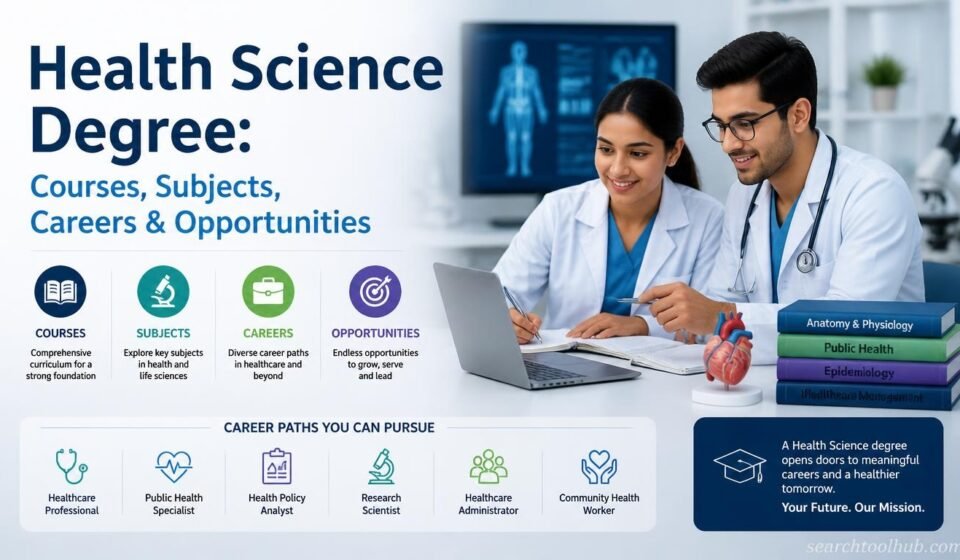

Healthcare is about much more than treating illnesses. It also involves understanding how the human body works, preventing diseases, improving community health, studying medical information, and developing better ways to deliver healthcare services. These activities bring together different scientific disciplines, creating a broad area of study known as health science.
A health science degree introduces students to the scientific principles behind human health and healthcare systems. Depending on the university and program, students may explore biology, anatomy, physiology, nutrition, public health, disease prevention, health research, and healthcare management.
For students interested in science and the healthcare sector, this degree can provide several academic and professional pathways. Some graduates continue into specialized health programs, while others explore research, public health, health administration, education, or related careers.
However, the term health science does not describe exactly the same qualification at every university. Some institutions offer a broad Bachelor of Health Science, while others provide more focused programs such as public health, biomedical science, or allied health sciences.
This guide explains what a health science degree involves, which subjects students may study, how admission and education pathways work, and what career opportunities may be available after graduation.
Health science is one of the important areas where scientific knowledge is applied to real-world challenges. Explore our Science: Meaning, Branches, Education, Careers, and Everyday Discoveries to learn about other scientific disciplines.
What Is a Health Science Degree?
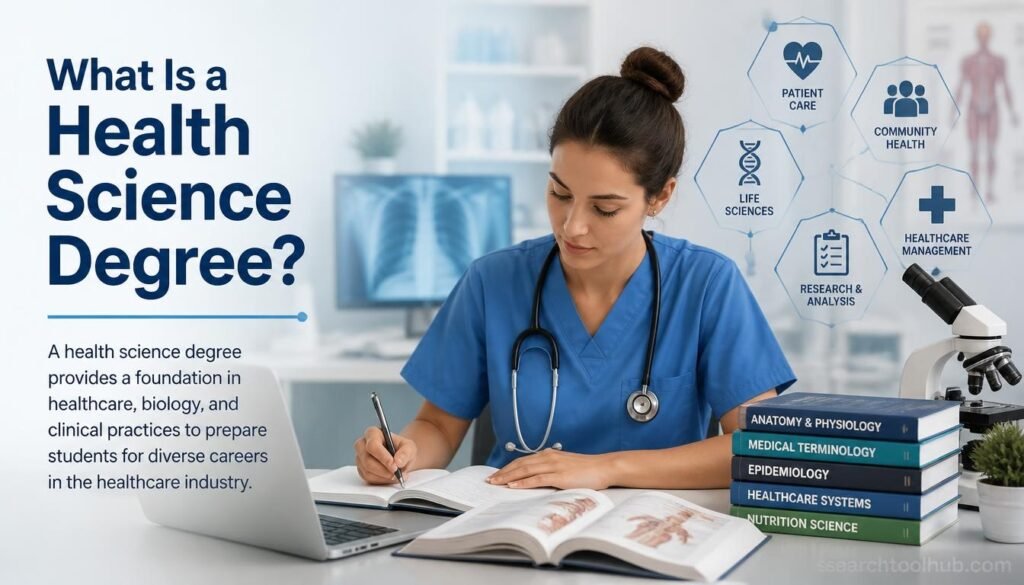
A health science degree is an academic qualification focused on the scientific, social, and practical aspects of human health and healthcare.
It examines factors that influence health, including biology, lifestyle, nutrition, the environment, healthcare services, and disease prevention.
Unlike a degree that trains students for one specific clinical profession, a broad health science program may introduce several areas of healthcare and allow students to choose a specialization.
For example, one student may become interested in public health research, while another may focus on health administration, biomedical research, or health information systems.
The exact content depends on the degree title, university curriculum, and available specializations.
It is important to understand that a general health science degree does not automatically qualify someone to work as a doctor, nurse, pharmacist, or other licensed healthcare professional. These professions have separate educational and registration requirements.
What Do You Learn in Health Science?
Health science investigates the biological, behavioral, social, and environmental influences on individual and community health and well-being.
Students may investigate questions such as:
- How does the human body respond to disease?
- What factors influence physical and mental well-being?
- How can communities reduce health risks?
- Why do certain diseases spread?
- How does nutrition affect the body?
- How can healthcare services become more effective?
- How is scientific research used to improve healthcare?
The subject combines scientific knowledge with practical applications. Students may complete laboratory activities, research assignments, case studies, community projects, or supervised field experience depending on their program.
Main Subjects in a Health Science Degree
Course structures vary between institutions, but several subjects are commonly connected with health science education.
1. Human Anatomy
Anatomy includes an analysis of the human being’s structural components.
Students learn about organs, tissues, bones, muscles, and the relationships between different body systems.
This knowledge provides a foundation for understanding health conditions and the effects of physical changes in the body.
2. Human Physiology
Physiology explains how the body functions.
Topics may include circulation, respiration, digestion, the nervous system, hormonal regulation, and other biological processes.
Students investigate how various systems interact to sustain normal bodily processes.
3. Biology
Biology is the scientific examination of organisms to exist.
Health science students may explore cells, genetics, microorganisms, biological processes, and the relationship between living systems and human health.
4. Microbiology
Microbiology focuses on microorganisms such as bacteria, viruses, fungi, and other microscopic life forms.
It helps students understand infection, disease transmission, laboratory testing, and the role of microorganisms in health and the environment.
5. Biochemistry
Biochemistry studies the chemical processes that take place within living organisms.
Students may explore proteins, carbohydrates, fats, enzymes, metabolism, and other chemical processes involved in normal body functions.
6. Nutrition
Nutrition examines how food and nutrients influence health and physical development.
Students may learn about dietary components, nutritional requirements, food safety, and the relationship between nutrition and certain health conditions.
7. Public Health
Public health aims to safeguard and improve the health of communities and people.
Topics may include health promotion, disease prevention, community health, health education, and public health planning.
8. Epidemiology
Epidemiology studies the distribution and patterns of health conditions within populations.
It helps researchers investigate disease trends, possible risk factors, and methods of prevention.
9. Biostatistics
Biostatistics applies statistical methods to health and biological research.
Students learn how to organize information, interpret research findings, compare results, and evaluate evidence.
10. Health Psychology
Health psychology examines how behavior, emotions, thoughts, and social conditions influence health.
It may explore topics such as stress, health habits, behavior change, and the psychological aspects of illness.
11. Environmental Health
Environmental health investigates how surroundings and environmental conditions affect human well-being.
Subjects may include air quality, water safety, sanitation, workplace conditions, and environmental risks.
12. Research Methods
Research methods teach students how to develop research questions, review scientific information, collect data, evaluate findings, and prepare academic reports.
These skills are useful for students interested in healthcare research and postgraduate education.
Different Types of Health Science Programs
Health science is a broad academic area. Universities may offer several related degrees, each with its own purpose and curriculum.
Bachelor of Health Science
A Bachelor of Health Science generally provides a broad introduction to health-related subjects.
Depending on the institution, students may study biological sciences, public health, health systems, research, health promotion, and other specialized areas.
Some programs allow students to select concentrations based on their interests.
Bachelor of Science in Public Health
Public health aims to improve health at the community and population levels.
Students may study epidemiology, biostatistics, health education, environmental health, disease prevention, and healthcare policy.
Bachelor of Biomedical Science
Biomedical science places a greater emphasis on the biological and laboratory basis of human health and illness.
Subjects may include anatomy, physiology, microbiology, genetics, pathology, and biochemistry.
Bachelor of Allied Health Sciences
Allied health sciences covers different professional and scientific areas that support healthcare services.
Depending on the university, programs may include specialized fields such as medical laboratory technology, medical imaging, rehabilitation-related disciplines, or other healthcare subjects.
Professional eligibility depends on the specific qualification and applicable regulatory requirements.
Bachelor of Health Administration
Health administration focuses on the organization and management of healthcare services.
Students may explore healthcare operations, planning, management, quality improvement, health systems, and organizational leadership.
Bachelor of Health Informatics
Health informatics combines healthcare knowledge with information technology.
It focuses on managing health information, digital medical records, healthcare data, and information systems used by healthcare organizations.
How Long Does a Health Science Degree Take?
The duration depends on the qualification, country, and university.
A bachelor’s degree commonly takes three to four years in many education systems. In Pakistan, several related public health undergraduate programs are structured as four-year degrees divided into eight semesters.
Postgraduate programs usually require additional study.
Some programs also include internships, laboratory placements, field experience, or a final research project.
Students should review the official curriculum to understand the actual study duration and graduation requirements.
Health Science Degree Admission Requirements
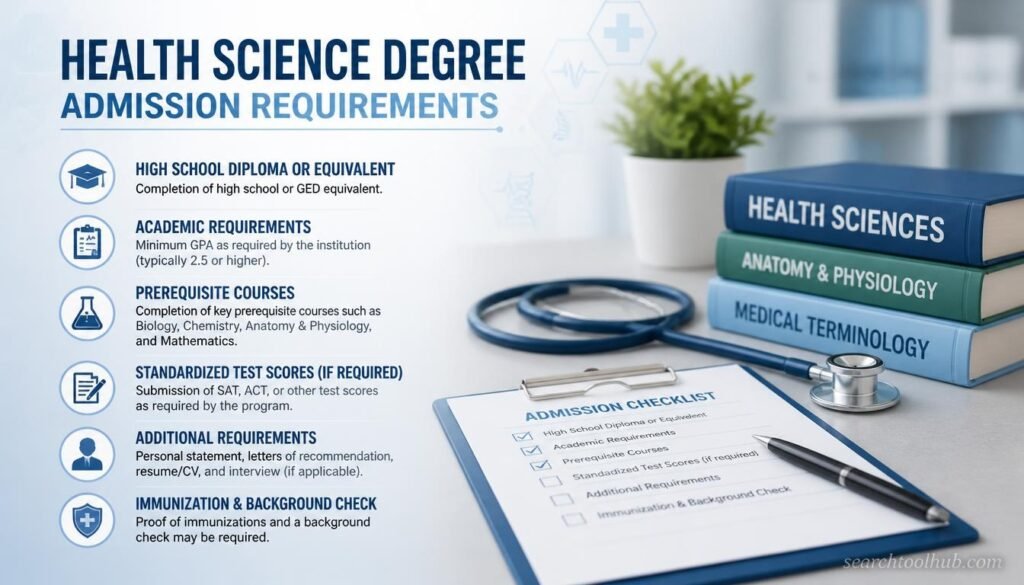
Admission requirements vary depending on the university and program.
For undergraduate study, institutions may consider:
- Completion of higher-secondary education or an equivalent qualification.
- Academic grades in relevant subjects.
- Biology, chemistry, mathematics, or other subject requirements.
- Entrance examinations, where applicable.
- Interviews or additional admission assessments, if required.
Some programs accept students from different academic backgrounds, while laboratory-based or specialized health programs may have stricter subject requirements.
For postgraduate study, applicants generally need an appropriate undergraduate qualification.
Before applying, students should check the official admission policy of their chosen university rather than assuming that all health science programs have identical requirements.
Studying Health Science in Pakistan
Students in Pakistan can explore several related undergraduate programs through universities offering health science, public health, and allied health education.
For example, the Higher Education Commission of Pakistan has published a curriculum framework for BS Public Health. It outlines an eight-semester program with a minimum of 125 credit hours, including internship or field experience and a capstone project.
Universities also publish their own program structures. Dow University of Health Sciences describes a four-year Bachelor of Science in Public Health program, while the University of Lahore publishes a separate four-year BSPH program structure.
These are examples of public health qualifications within the wider health science field, not evidence that every institution offers the same general Health Science degree.
When comparing universities, students should check:
- Recognition of the institution and the specific qualification.
- Current admission eligibility and required subjects.
- Course content and available specializations.
- Laboratory facilities and practical training.
- Internship and fieldwork opportunities.
- Research facilities and postgraduate pathways.
- Professional registration requirements, if the intended career is regulated.
Choosing a degree based only on its name can lead to confusion. The actual curriculum and professional eligibility are much more important.
Health Science Degree vs. Nursing
Health science and nursing are connected to healthcare, however they are not equivalent credentials.
A general health science degree may cover several areas, including public health, research, biological sciences, health administration, and healthcare systems.
A nursing degree is a professional education pathway focused on nursing practice, patient care, clinical skills, and the responsibilities of registered nursing professionals.
Nursing programs generally include structured clinical education and must meet the applicable professional requirements in the country where graduates intend to practice.
Students who want to become nurses should apply to an approved nursing program rather than assuming that a general health science qualification provides the same professional eligibility.
Health Science Degree vs. Biomedical Science
Both fields examine aspects of human health, but they often have different academic priorities.
Health science may cover a broad range of subjects related to healthcare systems, community health, disease prevention, research, and health services.
Biomedical science generally places greater emphasis on the biological mechanisms behind health and disease.
A student interested in population health or healthcare planning may prefer a public-health-focused program. Someone interested in laboratory research, cells, microorganisms, or disease processes may find biomedical science more relevant.
The best choice depends on the curriculum and the student’s long-term goals.
Specializations Within Health Science
Students may have the opportunity to focus on a particular area as they progress through their education.
Public Health
Public health focuses on disease prevention, health promotion, community well-being, and population-level research.
Biomedical Research
This area explores biological processes and scientific investigations related to human health and disease.
Nutrition and Health
Nutrition-related study examines food, dietary patterns, nutritional requirements, and their relationship with health.
Environmental Health
Environmental health examines the effects of environmental conditions on individuals and communities.
Health Administration
Health administration focuses on planning, organizing, and improving healthcare services.
Health Informatics
Health informatics is the integration of health information and technology to improve healthcare operations, research, and decision-making.
Epidemiology
Epidemiology studies health trends, illness distribution, risk factors, and preventative methods.
Health Education
Health education focuses on communicating useful health information and supporting healthier decisions within communities.
Not every university offers all these specializations. Some are separate degrees rather than options within a general health science program.
Career Opportunities After a Health Science Degree
Career opportunities depend on the degree’s actual content, practical training, location, and employer requirements.
A broad health science qualification may support entry into several non-clinical or research-related areas.
1. Public Health Assistant or Officer
Public health professionals may support community health programs, health promotion activities, disease prevention projects, and public health reporting.
The specific responsibilities and required qualifications vary by employer.
2. Health Research Assistant
Research assistants help with literature reviews, research documentation, data collection, participant coordination, and other research activities under appropriate supervision.
3. Health Program Coordinator
Program coordinators may help organize community health campaigns, educational activities, outreach projects, and healthcare-related initiatives.
4. Health Educator
Health educators develop and communicate information that helps people understand health risks, prevention, and healthy practices.
5. Epidemiology Assistant
Epidemiology assistants may support disease surveillance, data organization, research activities, and public health investigations.
Specialized epidemiology positions may require postgraduate qualifications or additional training.
6. Healthcare Administration Assistant
Graduates may explore administrative roles involving healthcare documentation, coordination, scheduling, reporting, and service organization.
7. Health Data Assistant
Health data professionals help organize and review healthcare information.
Additional training in databases, statistics, health information systems, and data analysis may be useful.
8. Community Health Worker
Community health workers support health education and outreach activities. Their eligibility, responsibilities, and training requirements depend on local health systems.
9. Laboratory Research Assistant
Graduates with suitable laboratory training may assist research teams with sample preparation, documentation, basic testing procedures, and laboratory organization.
Some laboratory positions require a more specialized biomedical or medical laboratory qualification.
10. Further Academic Study
Graduates may pursue postgraduate education in public health, biomedical sciences, epidemiology, health administration, health informatics, or related disciplines, subject to admission requirements.
A general health science degree should not be assumed to qualify graduates for every clinical position. Jobs involving diagnosis, prescribing, nursing practice, or other regulated activities require the relevant professional education and authorization.
Skills Needed for a Career in Health Science
Students can strengthen their academic and professional preparation by developing a combination of scientific and interpersonal skills.
Scientific understanding: Build a foundation in biology, human health, and research principles.
Communication: Learn to explain scientific information clearly to different audiences.
Critical thinking: Evaluate evidence carefully instead of accepting every claim without examination.
Research skills: Understand how to read studies, collect information, and interpret results.
Data literacy: Develop the ability to organize information, understand basic statistics, and recognize patterns.
Teamwork: Healthcare and research environments often involve collaboration between different professionals.
Ethical awareness: Respect confidentiality, informed consent, professional boundaries, and responsible research practices.
Organization: Maintain accurate records, manage assignments, and follow established procedures.
Is a Health Science Degree Worth It?
A health science degree can be a useful option for students interested in understanding health and exploring different areas of the healthcare sector.
Its value depends on the specific qualification and the career a student wants to pursue.
For example, a student interested in public health research may benefit from a program with strong epidemiology and biostatistics content. Someone interested in laboratory research should look for suitable practical training and biomedical subjects.
Before selecting a degree, students should ask:
- Does the curriculum match my interests?
- Is the university and qualification recognized?
- Does the program include practical experience?
- What jobs do graduates commonly pursue?
- Will I need additional qualifications for my intended career?
- Can I continue into a relevant postgraduate program?
A degree is more useful when it supports a clear academic or professional direction rather than being selected only because its title sounds attractive.
How to Prepare for Health Science Studies
Students can begin preparing before university by developing a foundation in relevant subjects.
- Review basic human biology and body systems.
- Strengthen knowledge of chemistry and biological processes.
- Learn introductory statistics and mathematics.
- Read reliable educational material about public health.
- Practice summarizing scientific information.
- Develop clear written and verbal communication skills.
- Learn basic research and data-handling concepts.
- Explore different health science specializations before choosing a degree.
It is also useful to compare university course outlines. Two programs with similar names may offer very different learning experiences.
The Future of Health Science
Healthcare is changing as research, technology, and public health needs continue to develop.
Several areas are influencing the future of health science.
Digital Healthcare
Electronic health records, remote healthcare services, and digital communication systems are changing how healthcare information is collected and used.
Medical Research
Scientific research continues to investigate diseases, biological processes, treatments, and methods of prevention.
Public Health Preparedness
Communities and health organizations need effective ways to monitor health risks, prepare for emergencies, and respond to changing disease patterns.
Health Data and Artificial Intelligence
Data analysis and artificial intelligence may support certain healthcare research and administrative activities. Their use requires careful evaluation, privacy protections, and appropriate professional oversight.
Preventive Healthcare
Greater attention to health education, early risk identification, nutrition, and community well-being highlights the importance of prevention alongside treatment.
Health science professionals may contribute to these developments through research, education, analysis, administration, and other specialized work.
Conclusion
A health science degree introduces students to the scientific and practical factors that influence human health and healthcare services. It can include subjects such as anatomy, physiology, biology, nutrition, public health, epidemiology, and research methods.
The field offers different academic directions, including public health, biomedical science, health administration, and health informatics. Depending on the qualification and additional training, graduates may explore research, community health, healthcare coordination, education, and other related careers.
Before applying, students should carefully compare course structures, university recognition, practical training, and professional requirements.
Health science is a broad area of education, and choosing the right program begins with understanding which part of healthcare genuinely interests you.
Frequently Asked Questions About Health Science Degrees
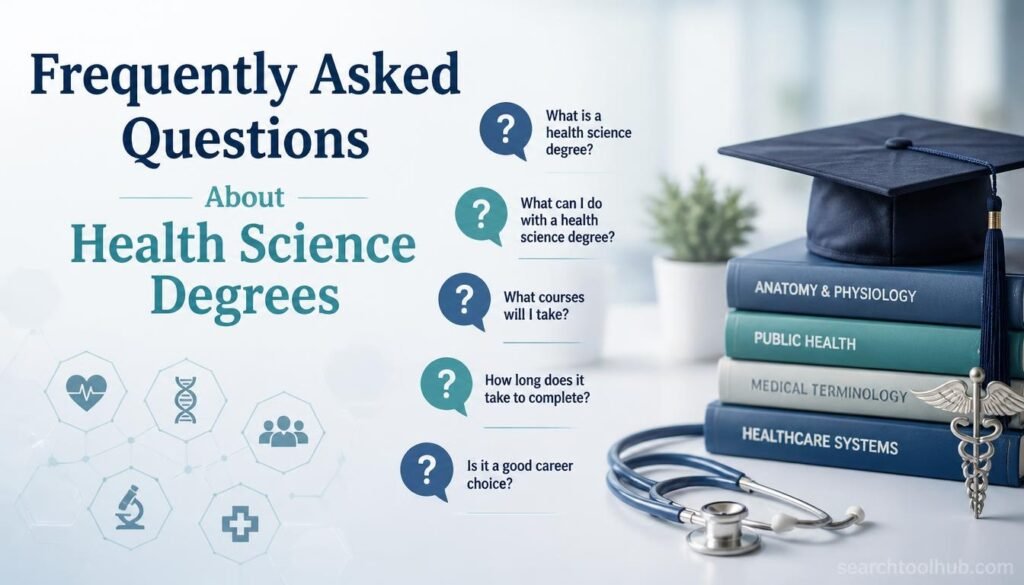
1. What is a health science degree?
A health science degree is an academic qualification that explores human health, disease prevention, healthcare systems, research, and related scientific subjects. The curriculum is particular to each university.
2. What subjects are included in health science?
Common subjects may include anatomy, physiology, biology, microbiology, biochemistry, nutrition, public health, epidemiology, biostatistics, and research methods.
3. How many years does a health science degree take?
A bachelor’s degree commonly takes three to four years, depending on the country and institution. Several related undergraduate programs in Pakistan follow a four-year structure.
4. Is health science the same as medical science?
No. Health science is a broad area covering different aspects of human health and healthcare. Medical science often focuses more directly on the scientific study of disease, diagnosis, treatment, and related biomedical subjects. Program definitions vary.
5. What jobs can you get with a health science degree?
Depending on the qualification, graduates may explore public health support, research assistance, health education, healthcare administration, community health, and health information-related roles.
6. Can I become a doctor with a health science degree?
A general health science degree does not qualify someone to practice as a doctor. Becoming a doctor requires completing the appropriate medical education and meeting the professional registration requirements of the relevant country.
7. Is health science a good degree in Pakistan?
It may be suitable for students interested in public health, biomedical research, health administration, and related fields. Students should check the recognition, curriculum, practical training, and career eligibility of their chosen program.
8. What is the difference between health science and public health?
Health science is a broad academic area covering several aspects of human health. Public health focuses more specifically on protecting and improving the health of communities and populations.
9. Can I study health science after intermediate?
Admission depends on the university and program. Some institutions require pre-medical subjects, while others may accept additional academic backgrounds. Applicants should check the current admission criteria.
10. Is biology necessary for health science?
Biology is important in many health science programs because it provides a foundation for understanding the human body, living systems, and disease. Specific admission requirements vary.
11. Can health science graduates work in hospitals?
Some graduates may qualify for administrative, research, coordination, or other non-clinical positions in hospitals. Clinical responsibilities generally require a separate professional qualification and authorization.
12. What is the difference between health science and nursing?
Health science is a broad academic field that may include research, public health, administration, and biological sciences. Nursing is a specialized professional education pathway focused on patient care and clinical nursing practice.
13. What is a Bachelor of Science in Public Health?
A Bachelor of Science in Public Health is an undergraduate qualification focused on population health, disease prevention, epidemiology, health promotion, and community health systems.
14. Can I pursue a master’s degree after health science?
Yes, depending on the undergraduate program and postgraduate admission requirements. Related options may include public health, health administration, biomedical sciences, epidemiology, and health informatics.
15. What should I check before choosing a health science university?
Check university recognition, the exact degree title, curriculum, admission requirements, laboratory and field training, internship opportunities, professional eligibility, and postgraduate study options.