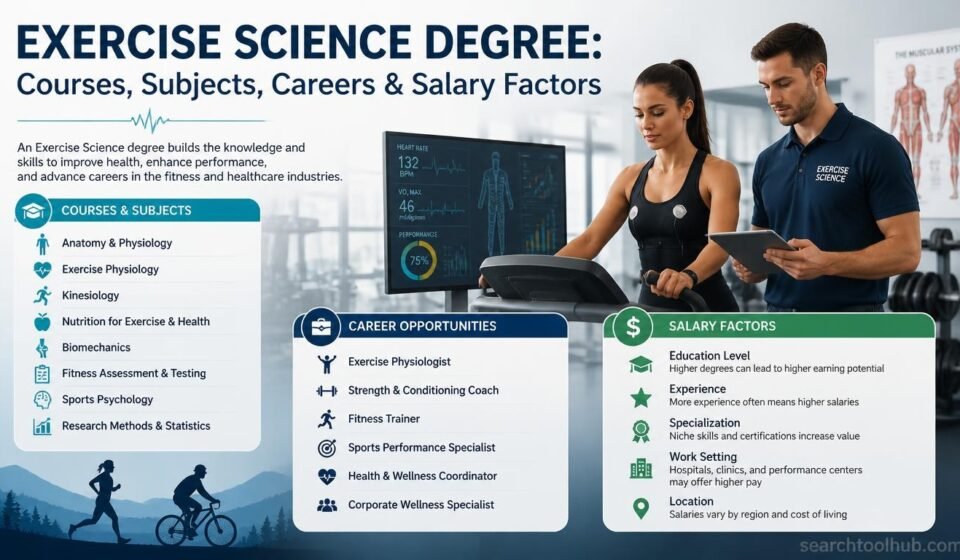

An exercise science degree is an academic qualification focused on understanding how the human body responds to physical activity, exercise, and movement. It combines subjects such as human anatomy, exercise physiology, biomechanics, nutrition, fitness assessment, and sports performance. Students learn how to apply scientific principles to improve physical fitness, support healthy lifestyles, and understand the relationship between movement and overall well-being.
This field is suitable for people interested in fitness, sports, human performance, health education, and scientific research. Depending on the university and specialization, graduates may pursue careers in fitness training, exercise testing, sports performance, wellness programs, or further study in related health professions.
Students interested in different scientific fields can also explore our complete guide to Science: Meaning, Branches, Education, Careers, and Everyday Discoveries to understand how exercise science fits into the wider world of scientific study.
What Is an Exercise Science Degree?
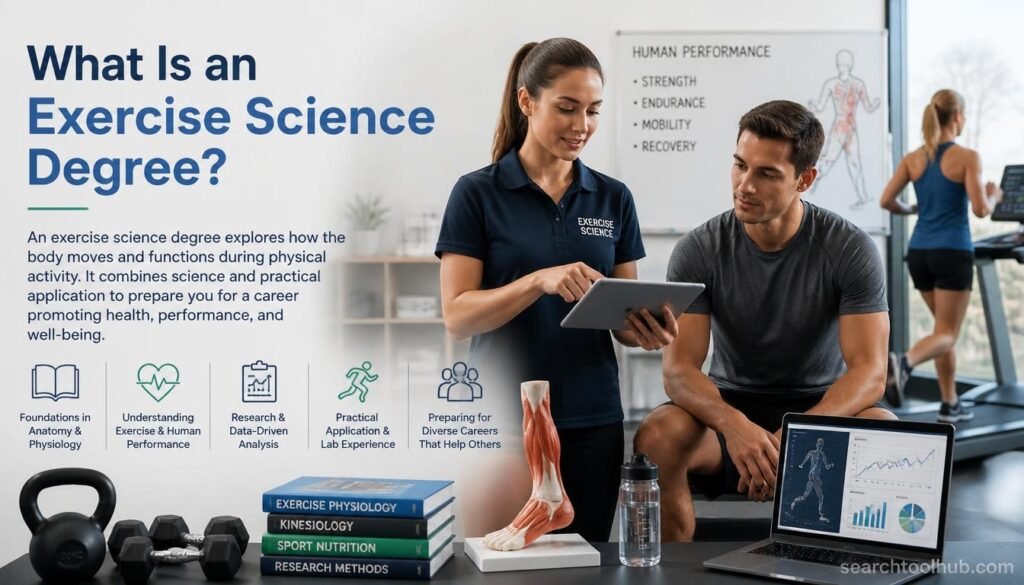
Exercise science is the study of physical activity and its effects on the human body. It examines how muscles, bones, the heart, lungs, and nervous system work during exercise and how training can influence strength, endurance, flexibility, and physical performance.
A degree in this field gives students a scientific foundation for understanding movement rather than relying only on practical workout experience. They study how exercise affects different body systems, how fitness can be measured, and how training programs can be planned for different goals and ability levels.
Some universities offer exercise science as a separate bachelor’s degree, while others include similar subjects in programs such as kinesiology, sports science, physical education, or human performance. Course names and professional recognition can vary between institutions and countries.
What Do You Study in an Exercise Science Degree?
The curriculum usually combines classroom learning, laboratory work, practical training, and sometimes supervised placements. The exact subjects depend on the university, but several areas are common across exercise science programs.
1. Human Anatomy and Physiology
Students learn about the structure and functions of the human body. Topics may include muscles, bones, joints, the cardiovascular system, and respiratory system.
This knowledge helps explain how the body produces movement and responds to different forms of physical activity.
2. Exercise Physiology
Exercise physiology examines the body’s immediate and long-term responses to exercise. Students explore how heart rate, oxygen consumption, muscle activity, and energy systems change during physical activity.
They may also study how training influences endurance, strength, recovery, and exercise tolerance.
3. Biomechanics and Human Movement
Biomechanics is the application of physics to human movement. It looks at how forces impact the body when doing things like running, walking, jumping, lifting, and throwing.
Understanding biomechanics can help professionals analyze movement techniques, improve performance, and recognize movement patterns that may increase injury risk.
4. Kinesiology
The scientific study of human movement is known as kinesiology. It discusses how the neurological system, muscles, joints, and bones interact.
Students learn how the body coordinates movement and how different physical activities require different movement skills.
5. Sports and Exercise Nutrition
Nutrition subjects explain how food and nutrients support energy production, recovery, and physical performance.
Students may study hydration, carbohydrates, proteins, fats, vitamins, minerals, and general nutrition principles for physically active people. Advanced clinical nutrition practice may require a separate qualification or professional registration.
6. Fitness Assessment and Exercise Testing
Students learn how physical fitness can be evaluated through structured tests and measurements.
Depending on the program, practical activities may include measuring cardiovascular endurance, muscular strength, flexibility, body composition, and movement performance.
7. Strength and Conditioning
This subject introduces the principles behind resistance training, muscular development, exercise progression, and conditioning programs.
Students examine how training variables such as intensity, frequency, volume, rest, and exercise selection influence physical adaptations.
8. Sports Psychology
Sports psychology explores the mental aspects of physical activity and athletic performance. Topics may include motivation, confidence, concentration, goal setting, stress management, and exercise participation.
9. Research Methods and Statistics
Scientific research is an important part of exercise science. Students learn how to understand research studies, collect information, analyze results, and evaluate whether a training method is supported by evidence.
Some programs also require a research project, practical assessment, internship, or final-year project.
How Long Does an Exercise Science Degree Take?
The duration depends on the qualification and the university.
| Qualification | Typical study period |
|---|---|
| Associate degree | Around 2 years |
| Bachelor’s degree | Around 3–4 years |
| Master’s degree | Around 1–2 additional years |
| Doctoral degree | Several additional years |
These are general estimates, not universal requirements. Some countries and universities use different academic structures.
A bachelor’s degree is a common starting point for students interested in professional exercise science roles. A postgraduate qualification may be useful for advanced research, teaching, or specialized clinical and performance-related pathways.
Exercise Science Degree Requirements
Admission requirements vary by country and institution. Many undergraduate programs expect applicants to have completed secondary education or an equivalent qualification.
Common admission considerations include:
- A recognized high school or intermediate qualification.
- Academic preparation in biology or other sciences, where required.
- Meeting the university’s minimum grades or entry test requirements.
- Submitting academic transcripts and application documents.
- Meeting English-language requirements if the program is taught in English and the applicant needs to demonstrate proficiency.
Students planning to study in Pakistan should check each university’s current admission criteria, degree title, recognition status, and course outline. Related programs may be offered under physical education, sports sciences, or other department names rather than the exact title Exercise Science.
Exercise Science Degree Specializations
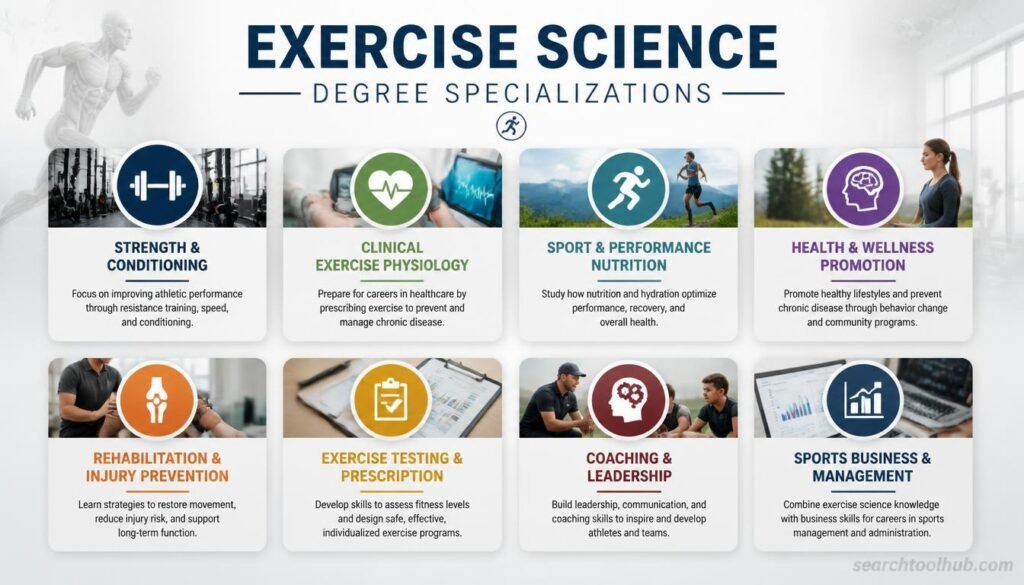
As students progress, they may have opportunities to focus on a particular area.
Exercise Physiology
This area examines how the body responds to exercise and how physical activity affects health and performance.
Sports Performance
Sports performance focuses on improving athletic abilities through training principles, performance assessment, recovery strategies, and movement analysis.
Strength and Conditioning
This specialization explores structured training programs designed to develop strength, power, speed, endurance, and other physical qualities.
Clinical Exercise Science
Clinical exercise science focuses on the relationship between physical activity and health. Depending on the qualification, professional credentials, and local regulations, practitioners may work with people who have specific health considerations.
Biomechanics
Biomechanics focuses on the mechanics of movement. It can be applied to sports technique, equipment design, movement analysis, and performance research.
Physical Activity and Health Promotion
This area explores ways to encourage regular physical activity and develop programs that support healthier communities and workplaces.
Careers With an Exercise Science Degree
An exercise science qualification can support several career directions. Your opportunities will depend on your degree, practical experience, professional certifications, and the rules governing the occupation where you intend to work.
1. Exercise Physiologist
Exercise physiologists study how the body responds to physical activity and develop exercise programs based on individual needs. Some work with people who have medically controlled health conditions.
The role may involve fitness assessments, exercise testing, progress monitoring, and collaboration with healthcare professionals. Clinical responsibilities depend on the practitioner’s qualifications and local requirements.
2. Exercise Scientist
Exercise scientists apply scientific knowledge to physical activity, fitness, and human performance. They may work in sports organizations, research settings, fitness facilities, or health and wellness programs.
3. Strength and Conditioning Coach
Strength and conditioning coaches help athletes and other clients develop physical abilities through planned training. Their work may involve strength development, speed, power, conditioning, and performance monitoring.
4. Personal Trainer
Personal trainers help clients follow exercise programs that match their fitness goals and abilities. Professional certification, practical competence, and appropriate insurance or registration may be required depending on the location.
5. Sports Performance Specialist
Sports performance specialists work with athletes to evaluate physical abilities and support improvements in training and performance.
Some positions require additional qualifications or experience in sports science, coaching, or performance analysis.
6. Fitness and Wellness Coordinator
These professionals help organize physical activity and wellness initiatives in fitness centers, organizations, educational institutions, or workplaces.
7. Research Assistant
Graduates interested in scientific investigation may assist with studies involving exercise physiology, biomechanics, sports performance, or physical activity.
Research roles may require further academic training as responsibilities become more specialized.
Exercise Science Degree Salary: What Affects Earnings?
There is no single salary for everyone with an exercise science degree. Earnings depend on the job title, qualifications, experience, employer, location, and type of work.
For example, a personal trainer, sports performance coach, and clinical exercise physiologist perform different duties and may have different education and certification requirements. Their earnings should not be treated as interchangeable.
Important salary factors include:
- Location: Pay levels differ between countries, cities, and local job markets.
- Education: A postgraduate qualification may help with some specialized or research-focused positions.
- Professional certification: Recognized credentials can support eligibility for particular roles.
- Experience: Practical experience and a strong professional record can influence employment opportunities.
- Employer: Hospitals, sports organizations, universities, fitness centers, and private businesses may offer different compensation structures.
- Specialization: Roles involving advanced testing, performance analysis, or clinical experience may have different requirements and pay levels.
In the United States, the Bureau of Labor Statistics reported a median annual wage of $59,460 for exercise physiologists in May 2025. This figure applies to that specific occupation and country; it should not be used as a salary estimate for graduates in Pakistan or elsewhere.
Students should research local job advertisements and employer requirements before choosing a degree based on expected income.
Is an Exercise Science Degree Worth It?
An exercise science degree can be a worthwhile choice for students who want to understand the science behind physical activity and build a career connected to fitness, movement, sports, or health promotion.
Its value depends on how well the program matches your career goals. A strong course should offer relevant science subjects, practical learning, qualified instructors, appropriate laboratory facilities, and opportunities to gain supervised experience.
Before enrolling, consider the following:
- Does the university offer a recognized qualification?
- Does the curriculum include exercise physiology and biomechanics?
- Are practical assessments or internships available?
- Does the program prepare students for the professional certifications they may want?
- What jobs do graduates commonly pursue?
- Are additional qualifications required for your intended career?
A degree alone does not automatically qualify someone to work as a physiotherapist, physician, dietitian, or other regulated healthcare professional. Those careers have separate educational and licensing requirements.
Exercise Science vs. Sports Science vs. Kinesiology
These subjects overlap, but their emphasis can differ.
| Field | Main focus |
|---|---|
| Exercise Science | How physical activity affects the body, fitness, and health |
| Sports Science | Scientific principles applied to athletic performance and sport |
| Kinesiology | Human movement, including its physical, mechanical, and behavioral aspects |
Universities do not always use these terms in exactly the same way. Students should compare actual course content rather than choosing a program based only on its name.
Exercise Science Degree in Pakistan
Students in Pakistan may find related academic pathways through universities offering physical education, sports sciences, sports and exercise physiology, or human performance subjects.
The Higher Education Commission’s Physical Education curriculum materials include areas such as sports and exercise physiology, sports biomechanics, athletic training and conditioning, and human performance analysis. These subjects demonstrate how exercise-related scientific topics can appear within related academic programs.
However, a program titled Physical Education or Sports Sciences is not automatically identical to an Exercise Science degree. Students should review the official curriculum, university recognition, available facilities, admission requirements, and career pathways before applying.
If your goal is to work internationally, also check whether the degree meets the academic requirements of the professional certification or employer you are targeting.
Skills Needed for an Exercise Science Career
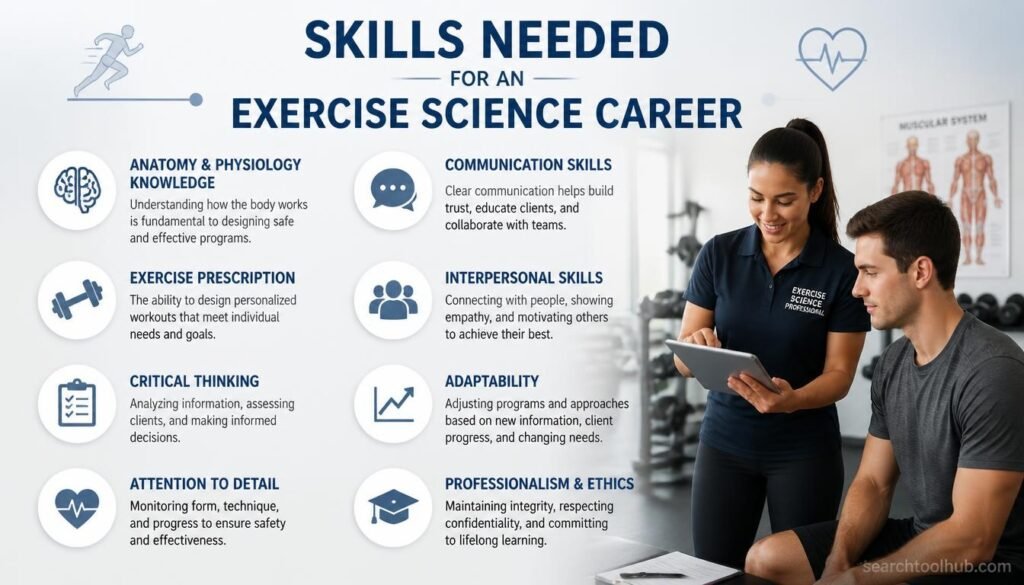
Academic knowledge is important, but successful professionals also need practical and communication skills.
Useful abilities include:
- Understanding human anatomy and exercise physiology.
- Evaluating physical activity and fitness information.
- Explaining exercise principles clearly.
- Designing appropriate training plans within professional boundaries.
- Understanding research and interpreting scientific evidence.
- Monitoring progress and keeping accurate records.
- Working with people from different age groups and fitness backgrounds.
- Recognizing when a client needs assessment or support from another qualified professional.
Practical experience, continuing education, and professional development can help graduates strengthen these skills over time.
Frequently Asked Questions
1. What can you do with an exercise science degree?
Graduates may pursue roles such as exercise scientist, exercise physiologist, strength and conditioning coach, personal trainer, sports performance specialist, wellness coordinator, or research assistant. Specific positions may require additional certification, postgraduate study, or professional registration.
2. Is exercise science a medical degree?
No. Exercise science is a field focused on physical activity, human movement, fitness, and exercise responses. It does not automatically qualify graduates to practice medicine or another regulated clinical profession.
3. How many years is an exercise science degree?
A bachelor’s degree commonly takes three to four years, although the duration depends on the country and university. Postgraduate study takes additional time.
4. Is biology important for exercise science?
Yes. Biology provides a useful foundation for understanding human anatomy, muscles, body systems, and exercise physiology. Some universities specifically require previous study in biology or related sciences.
5. Can I become a personal trainer with an exercise science degree?
An exercise science degree can provide useful academic knowledge for personal training. However, employers or professional organizations may require a separate personal training certification, practical assessment, or other credentials.
6. Can exercise science graduates work in hospitals?
Some graduates pursue hospital-based exercise physiology or wellness roles. These positions may require specific qualifications, professional credentials, supervised experience, and compliance with local healthcare regulations.
7. What is the difference between exercise science and physical therapy?
Exercise science studies physical activity, exercise responses, fitness, and human performance. Physical therapy is a regulated healthcare profession focused on assessing and treating movement limitations, injuries, and certain health conditions. Becoming a physical therapist generally requires a separate professional degree and licensing process.
8. Is exercise science a good choice for sports careers?
It can be a useful academic pathway for careers involving sports performance, strength and conditioning, exercise testing, and sports research. The best route depends on the student’s preferred role and the qualifications required by employers.
Final Thoughts
An exercise science degree connects scientific learning with practical applications in fitness, sports, human movement, and physical activity. Students explore how the body works during exercise and how evidence-based training can support physical performance and well-being.
Before choosing a university, compare its curriculum, practical opportunities, recognition, and professional pathways. Selecting a program that matches your long-term career plans is more important than choosing a degree based on its title alone.